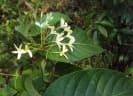
Holarrhena pubescens
Holarrhena pubescens
Safety & Hazards
None known
Cultivation Details
Though sensitive to frost, the plant recovers easily from damage[1]. Succeeds on a wide range of soils[2]. Plants can stand slight shade but develop best when growing in full light[1]. Established plants are drought tolerant[1]. The tree coppices well and can survive bush fires by producing sucker shoots from burned-down stumps[1]. Juvenile plants are more susceptible to damage by fire than older ones[1]. Natural reproduction is abundant owing to regular and copious seeding from an early age, comparative immunity of the plant to damage by animals and its power of recovery from injury[1]. Seeds, that are dispersed by wind germinate during the early rains, and seedlings attain 10 - 15 cm by the end of the first year[1]. In subsequent years, growth is more rapid, the mean annual diameter increment being 7 - 8 mm. In India, early height increment of Holarrhena pubescens is low, only 10 - 15 cm/year under natural conditions[1]. Established plants are fast-growing[1]. All parts of the plant contain a milky sap[3].
Propagation
Seed - direct sowing or raising seedlings in a nursery both work well. Fresh seeds have a high percentage of germination, but in seeds more than one year old the viability is low[1]. The seed usually germinates in 2 - 3 weeks[1]. Cite as: Tropical Plants Database, Ken Fern. tropical.theferns.info. 2026-02-20. <tropical.theferns.info/viewtropical.php?id=Holarrhena+pubescens>
Pollinators
Data unavailable
References
- [1]Protabase - Plant Resources of Tropical Africa. — http://www.prota.org ↩︎An excellent on-line database with detailed information on over 3,200 species of useful plants of Africa.
- [2]Plant Resources of Southeast Asia — http://proseanet.org/ ↩︎Lots of information on the uses of the plants of SE Asia.
- [3]Medicinal Plants in Vietnam — Nguyen Van Dan & Doan Thi Nhu · World Health Organisation · 1989 · ISBN 92 9061 101 4 ↩︎An excellent book, giving information on over 200 plants, their medicinal compounds and applications.
- [4]Flora of China — Missouri Botanical Garden Press; St. Louis. · 1994 · http://flora.huh.harvard.edu/china/ ↩︎An excellent, comprehensive resource in 25 volumes. In addition to the botanical information the flora also gives basic information on habitat and some uses. An on-line version is also available.
- [5]Flora Zambesiaca — http://apps.kew.org/efloras/fz/intro.html ↩︎An excellent online flora of plants from the Zambezi River basin. It lists a number of the plant uses as well as the habitats and botanical descriptions of the plants.
- [6]IUCN Red List of Threatened Species — http://www.iucnredlist.org/ ↩︎A list of plants under threat and facing possible extinction, usually with brief details of the threats and information on habitat.