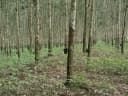
Cultivation Details
Succeeds in humid lowland tropical areas, growing best at elevations of 300 - 500 metres, but also succeeding at elevations up to 900 metres[2]. Planting above 400 - 500 metres is not generally recommended because trees at higher altitudes tend to be smaller, with less vigorous growth, and with reduced production of both latex and timber[2]. It grows best in areas where the mean annual temperature is in the range 23 - 35°c, and a mean annual rainfall of 1,500 - 3,000mm, though it can tolerate up to 4,000mm[2]. In some areas, rubber can tolerate a 2 - 3 month period of drought[2]. Prefers a fertile, moisture-retentive soil in light shade[3]. Plants tolerate some waterlogging[2]. Tolerant of a wide pH range from 4 - 8, though it does better in acid soils[2]. Lime is harmful, and shallow or poorly drained or peaty soils should be avoided. Thrives best in deep, well-drained loamy soil covered by natural undergrowth or a leguminous cover crop and protected from erosion[2]. Requires protection from strong winds[4]. Plants can be tapped for their latex from about the age of 7 years[3]. The root system has a well-developed taproot with far-spreading lateral roots[2]. In high-rainfall areas, good internal drainage of the soil is important. Strong winds may snap trunks and branches; however, more wind-resistant clones do exist[2]. Only a few clones are self-incompatible, but most benefit from cross-pollination or from hand pollination[2]. The economic life cycle of a rubber plantation is 30 - 35 years, after which replanting is necessary[2].
Propagation
Seed - it only has a short viability of 7 - 10 days and so should be sown as soon as possible[5, 2]. The seed is often sown in situ - usually 2 or more seeds per hole are planted, and then the seedlings are selectively thinned[2]. The seeds can also be planted in a nursery bed. Seeds germinate in 1 - 3 weeks, depending on climatic conditions and freshness[2]. It germinates best at a temperature of about 25°c[6]. Seedlings grow to a height of 1 - 1.5 metres in 6 months[2]. Seed storage behaviour is recalcitrant; viability can be maintained for 3 months in moist storage with moist charcoal and sawdust in a perforated polythene bag at 7 - 10°c. Whole seed moisture content is 36%; lowest safe moisture content is 20%, and no seeds survive further desiccation to 15% mc[2]. Seeds are killed on exposure to -5 °c for 3 - 4 hours. Commercial clonal seed are stored in cold storage at about 4°c, which often gives reduced but tolerable germination[2]. Vegetative propagation is by budding or cuttings. Seedlings make good cuttings, but cuttings from older, rubber-bearing trees take very poorly or not at all[2]. Cite as: Tropical Plants Database, Ken Fern. tropical.theferns.info. 2026-02-20. <tropical.theferns.info/viewtropical.php?id=Hevea+brasiliensis>
Pollinators
Wind, insects
References
- [1]Journal of the Arnold Arboretum Vol. 37 — Harvard University · 1956 · http://www.biodiversitylibrary.org ↩︎Amongst other articles, it contains an excellent article on the food uses of the genus Hevea. It can be downloaded from the Internet.
- [2]World Agroforesty Centre — http://www.worldagroforestry.org/ ↩︎An excellent online database of a huge range of trees giving very good information on each plant - its uses, ecology, identity, propagation, pests etc.
- [3]Tropical and Subtropical Trees - A Worldwide Encyclopaedic Guide. — Barwick. M. · Thames & Hudson, London · 2004 · ISBN 0-500-51181-0 ↩︎A superb book, very concise and well written, giving a wealth of information on 400 or more species including descriptions, habitat, cultivation details and plant uses. A wealth of colour photographs bring each plant vividly to life.
- [4]Ecocrop — http://ecocrop.fao.org/ecocrop/srv/en/home ↩︎Basic information on a wide range of useful plants, plus details of environmental needs where available.
- [5]The New RHS Dictionary of Gardening. 1992. — Huxley. A. · MacMillan Press · 1992 · ISBN 0-333-47494-5 ↩︎Excellent and very comprehensive, though it contains a number of silly mistakes. Readable yet also very detailed.
- [6]Vegetables in the Tropics — Tindall. H. D. · MacMillan, Oxford. · 1983 · ISBN 0-333-24268-8 ↩︎An excellent, in-depth look at the main vegetable crops that can be grown in the Tropics, plus many less well-known plants.
- [7]Dictionary of Economic Plants. — Uphof. J. C. Th. · Weinheim · 1959 · ISBN - ↩︎An excellent and very comprehensive guide but it only gives very short descriptions of the uses without any details of how to utilize the plants. Not for the casual reader.
- [PFAF]Plants for a Future — pfaf.org ↩︎