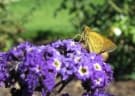
Heliotropium arborescens
Heliotropium arborescens
Safety & Hazards
The seeds are poisonous[1]. No other specific mention of toxicity has been seen for this species, but many members of this plant family (Boraginaceae) are known to contain pyrrolizidine alkaloids. These alkaloids have a cumulative effect upon the body and, unless concentrations in a plant are high, occasional use is generally completely safe. They are derived from amino acids including ornithine. Many pyrrolizidine alkaloids have pronounced hepatic toxicity, but the lungs and other organs may be affected as well. Mutagenic and carcinogenic activities of pyrrolizidine alkaloids have also been reported[2].
Cultivation Details
Heliotropium arborescens is a plant of seasonally dry areas of the tropics, found from sea level to more than 3,000 metres. It cannot tolerate frost, though it grows quickly enough to be used as an annual in temperate gardens. It requires a minimum winter temperature of 5 - 7°c[3]. Plants stop growing when night-time temperatures fall below 5°c and are likely to be killed once the temperature falls below -2°c[4]. Prefers a rich well-drained soil in full sun[3]. Plants grow best in a sandy loam[4]. The plant turns its leaves and flowers so that it is always facing the sun during the day[5]. The flowers have a most unusual perfume, somewhat like cherries baked in a pie[6]. It is a good butterfly plant[7, 8]. There are many named varieties[3].
Propagation
Seed - sow early spring in a greenhouse and only just cover the seed. Germination usually takes place within 2 - 25 days at 20°c. When they are large enough to handle, prick the seedlings out into individual pots and plant them out after the last expected frosts. Cuttings of half-ripe wood, 5 - 7cm with a heel, mid summer in a frame[9]. High percentage. Because the plant is not hardy the cuttings would have to be grown in a greenhouse for the winter before planting them out in the spring. Cuttings of young shoots in the spring[10]. Because the plant is not hardy the cuttings would have to be grown in a greenhouse for the winter before planting them out in the spring. Cite as: Temperate Plants Database, Ken Fern. temperate.theferns.info. 2026-02-21. <temperate.theferns.info/plant/Heliotropium+arborescens>
Pollinators
Bees, Lepidoptera
References
- [1]A Colour Atlas of Poisonous Plants. — Frohne. D. and Pfänder. J. · Wolfe · 1984 · ISBN 0723408394 ↩︎Brilliant. Goes into technical details but in a very readable way. The best work on the subject that I've come across so far.
- [2]Protabase - Plant Resources of Tropical Africa. — http://www.prota.org ↩︎An excellent on-line database with detailed information on over 3,200 species of useful plants of Africa.
- [3]The New RHS Dictionary of Gardening. 1992. — Huxley. A. · MacMillan Press · 1992 · ISBN 0-333-47494-5 ↩︎Excellent and very comprehensive, though it contains a number of silly mistakes. Readable yet also very detailed.
- [4]Conservatory and Indoor Plants Volumes 1 & 2 — Phillips. R. & Rix. M. · Pan Books, London. · 1998 · ISBN 0-330-37376-5 ↩︎Excellent photos of over 1,100 species and cultivars with habits and cultivation details plus a few plant uses. Many species are too tender for outdoors in Britain though there are many that can be grown outside.
- [5]A Modern Herbal. — Grieve. · Penguin · 1984 · ISBN 0-14-046-440-9 ↩︎Not so modern (1930's?) but lots of information, mainly temperate plants.
- [6]Scented Flora of the World. — Genders. R. · Robert Hale. London. · 1994 · ISBN 0-7090-5440-8 ↩︎An excellent, comprehensive book on scented plants giving a few other plant uses and brief cultivation details. There are no illustrations.
- [7]Making a Wildlife Garden. — Baines. C. ↩︎Fairly good with lots of ideas about creating wildlife areas in the garden.
- [8]Butterflies and Moths in Britain and Europe. — Carter D. · Pan · 1982 · ISBN 0-330-26642-x ↩︎An excellent book on Lepidoptera, it also lists their favourite food plants.
- [9]Propagation of Trees, Shrubs and Conifers. — Sheat. W. G. · MacMillan and Co · 1948 · ISBN - ↩︎A bit dated but a good book on propagation techniques with specific details for a wide range of plants.
- [10]RHS Dictionary of Plants plus Supplement. 1956 — F. Chittendon. · Oxford University Press · 1951 · ISBN - ↩︎Comprehensive listing of species and how to grow them. Somewhat outdated, it has been replaced in 1992 by a new dictionary (see [ 200 ]).
- [11]Plants for Man. — Schery. R. W. ↩︎Fairly readable but not very comprehensive. Deals with plants from around the world.
- [12]Economic Botany. — Hill. A. F. · The Maple Press · 1952 · ISBN - ↩︎Not very comprehensive, but it is quite readable and goes into some detail about the plants it does cover.