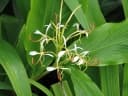
Hedychium spicatum
Hedychium spicatum
Safety & Hazards
None known
Cultivation Details
Hedychium spicatum is a plant of subtropical to tropical regions. It is not very cold-hardy, tolerating short-lived temperatures falling to about -2°c[1, 2]. It can be grown outdoors in the milder regions of the temperate zone if placed against a sunny wall and given a good mulch in the winter[1, 2]. This is probably the hardiest species in the genus, generally succeding outdoors in zone 8, especially if the rhizomes are mulched with dry leaves in the autumn[3]. Dormant plants have been known to withstand temperatures down to -16°c in Germany[4]. Requires a rich moist soil and a sunny position[5]. Plants can be grown in a sunny border as a summer sub-tropical bedding plant[[1]. Plants seem to be immune to the predations of rabbits[5]. The tubers should only just be covered with soil[5]. The flowers are sweetly scented, the scent being most pronounced towards evening[6]. Both the bruised and the dried root are very aromatic with a fragrant, somewhat pungent smell that is similar to orris root but more powerful[6].
Propagation
Seed - best sown as soon as it is ripe in a warm greenhouse at 18°c[2]. Prick out the seedlings into individual pots when they are large enough to handle and grow them on for at least their first winter in the greenhouse. Plant out in late spring after the last expected frosts. Division as growth commences in the spring[2]. Dig up the clump and divide it with a sharp spade or knife, making sure that each division has a growing shoot. Larger clumps can be planted out direct into their permanent positions, but it is best to pot up the smaller divisions and grow them on in a greenhouse until they are established. Plant them out in the summer or late in the following spring. Cite as: Temperate Plants Database, Ken Fern. temperate.theferns.info. 2026-02-21. <temperate.theferns.info/plant/Hedychium+spicatum>
Pollinators
Data unavailable
References
- [1]RHS Dictionary of Plants plus Supplement. 1956 — F. Chittendon. · Oxford University Press · 1951 · ISBN - ↩︎Comprehensive listing of species and how to grow them. Somewhat outdated, it has been replaced in 1992 by a new dictionary (see [ 200 ]).
- [2]The New RHS Dictionary of Gardening. 1992. — Huxley. A. · MacMillan Press · 1992 · ISBN 0-333-47494-5 ↩︎Excellent and very comprehensive, though it contains a number of silly mistakes. Readable yet also very detailed.
- [3]Bulbs — Phillips. R. and Rix. M. · Pan Books · 1989 · ISBN 0-330-30253-1 ↩︎Superbly illustrated, it gives brief details on cultivation and native habitat.
- [4]The New Plantsman. Volume 1, 1994. — Matthews. V. · Royal Horticultural Society · 1994 · ISBN 1352-4186 ↩︎A quarterly magazine, it has articles on Himalayacalamus hookerianus, hardy Euphorbias and an excellent article on Hippophae spp.
- [5]Perennial Garden Plants — Thomas. G. S. · J. M. Dent & Sons, London. · 1990 · ISBN 0 460 86048 8 ↩︎A concise guide to a wide range of perennials. Lots of cultivation guides, very little on plant uses.
- [6]Scented Flora of the World. — Genders. R. · Robert Hale. London. · 1994 · ISBN 0-7090-5440-8 ↩︎An excellent, comprehensive book on scented plants giving a few other plant uses and brief cultivation details. There are no illustrations.
- [7]Plants for Human Consumption. — Kunkel. G. · Koeltz Scientific Books · 1984 · ISBN 3874292169 ↩︎An excellent book for the dedicated. A comprehensive listing of Latin names with a brief list of edible parts.
- [8]Cornucopia - A Source Book of Edible Plants. — Facciola. S. · Kampong Publications · 1990 · ISBN 0-9628087-0-9 ↩︎Excellent. Contains a very wide range of conventional and unconventional food plants (including tropical) and where they can be obtained (mainly N. American nurseries but also research institutes and a lot of other nurseries from around the world.
- [9]Glossary of Indian Medicinal Plants (Including the Supplement). — Chopra. R. N., Nayar. S. L. and Chopra. I. C. · Council of Scientific and Industrial Research, New Delhi. · 1986 · ISBN - ↩︎Very terse details of medicinal uses of plants with a wide range of references and details of research into the plants chemistry. Not for the casual reader.
- [10]Medicinal Plants of Nepal — Dept. of Medicinal Plants. Nepal. · 1993 · ISBN - ↩︎Terse details of the medicinal properties of Nepalese plants, including cultivated species and a few imported herbs.
- [11]Plants and People of Nepal — Manandhar. N. P. · Timber Press. Oregon. · 2002 · ISBN 0-88192-527-6 ↩︎Excellent book, covering over 1,500 species of useful plants from Nepal together with information on the geography and peoples of Nepal. Good descriptions of the plants with terse notes on their uses.
- [12]Ethnopharmacological survey, Phytochemical screening and Antibacterial activity measurements of high altitude medici — Lamichhane J. et al · 2014 ↩︎
- [13]Tibetan Medicinal Plants — Tsarong. Tsewang. J. · Tibetan Medical Publications, India · 1994 · ISBN 81-900489-0-2 ↩︎A nice little pocket guide to the subject with photographs of 95 species and brief comments on their uses.
- [14]Dictionary of Economic Plants. — Uphof. J. C. Th. · Weinheim · 1959 · ISBN - ↩︎An excellent and very comprehensive guide but it only gives very short descriptions of the uses without any details of how to utilize the plants. Not for the casual reader.
- [15]CosIng — http://ec.europa.eu/growth/tools-databases/cosing/ ↩︎CosIng is the European Commission database for information on cosmetic substances and ingredients.