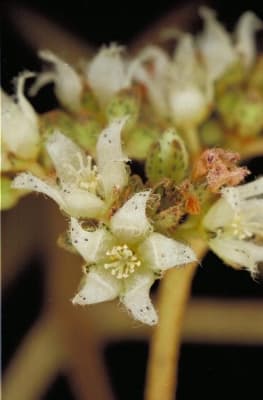
Harungana madagascariensis
Harungana madagascariensis
Safety & Hazards
None known
Cultivation Details
A plant of the moist tropics, where it is found at elevations up to 1,800 metres. It grows best in areas where annual daytime temperatures are within the range 20 - 28°c, but can tolerate 12 - 36°c[1]. It prefers a mean annual rainfall in the range 1,500 - 2,500mm, but tolerates 1,000 - 3,500mm[1]. Requires a sunny position[1]. Succeeds in a range of fertile soils[1]. Prefers a pH in the range 5.5 - 6.5, tolerating 5 - 7.5[1]. The plant forms dense thickets which exclude other species and can possibly become a permanent component of tropical rainforests, potentially making it weedy[2]. A fast-growing tree, especially when young[2]. The tree responds well to coppicing[2].
Propagation
Seed - it has a short viability and is best kept in sealed containers and sown within two months of harvest[2]. Cite as: Tropical Plants Database, Ken Fern. tropical.theferns.info. 2026-02-20. <tropical.theferns.info/viewtropical.php?id=Harungana+madagascariensis>
Pollinators
Bees
References
- [1]Ecocrop — http://ecocrop.fao.org/ecocrop/srv/en/home ↩︎Basic information on a wide range of useful plants, plus details of environmental needs where available.
- [2]World Agroforesty Centre — http://www.worldagroforestry.org/ ↩︎An excellent online database of a huge range of trees giving very good information on each plant - its uses, ecology, identity, propagation, pests etc.
- [3]Flora Zambesiaca — http://apps.kew.org/efloras/fz/intro.html ↩︎An excellent online flora of plants from the Zambezi River basin. It lists a number of the plant uses as well as the habitats and botanical descriptions of the plants.
- [4]The Useful Plants of West Tropical Africa. — Burkil. H. M. · Royal Botanic Gardens; Kew. · 1985 - 2004 ↩︎Brief descriptions and details of the uses of over 4,000 plants. A superb, if terse, resource, it is also available electronically on the Web - see http://www.aluka.org/
- [5]Mansfeld's Database of Agricultural and Horticultural Plants — http://mansfeld.ipk-gatersleben.de/pls/htmldb_pgrc/f?p=185:3:4292127278597336 ↩︎Terse details of a huge range of useful plants.
- [6]African Flowering Plants Database — Conservatoire et Jardin Botaniques. · http://www.ville-ge.ch/musinfo/bd/cjb/africa/recherche.php ↩︎Contains information on over 150,000 plant names (including synonyms) giving a description and habitat, plus a distribution map.
- [7]Edible Wild Plants of Tanzania — Ruffo, C.K.: Birnie, A. & Tengnas, B. · Regional Land Management Unit; Nairobi. · 2002 · ISBN 9966-896-60-0 ↩︎A very well presented, simple guide to growing and utilizing wild food plants in Tanzania, with line drawings of each plant, a description, habitat and range, non-food as well as food uses, plus basic information on growing the plants.