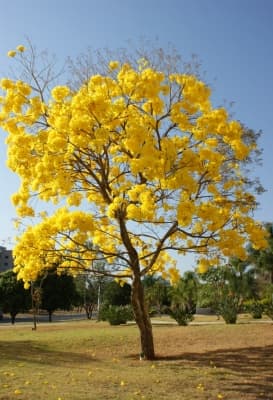
Handroanthus serratifolius
Handroanthus serratifolius
Safety & Hazards
The fine yellow dust arising when sawing or planing the wood has an irritating effect if inhaled and at times is reported to cause mild dermatitis[1].
Cultivation Details
A plant of the moist, lowland tropics where it is found at elevations up to 800 metres. It grows best in areas where annual daytime temperatures are within the range 24 - 32°c, but can tolerate 20 - 36°c[2]. It can be killed by temperatures of 5°c or lower[2]. It prefers a mean annual rainfall in the range 700 - 1,700mm, but tolerates 500 - 2,000mm[2]. Young plants can tolerate some shade, but they need increasing levels of light as they grow[3]. Prefers a well-drained soil, often found growing wild on slopes[3]. Prefers a pH in the range 5 - 7, tolerating 4.5 - 7.5[2]. Seedling plants establish moderately well when planted out and can reach a height of 3 metres within 2 years[3]. A slow-growing species, it is considered to be unsuitable for plantation cultivation[4].
Propagation
Seed - it has a short period of viability and so should be sown as soon as it is ripe[5]. The seeds can be sown in a semi-shaded position in a nursery seedbed or individual containers. High germination rate is usually obtained within 8 - 10 days. Seedlings develop quickly and are usually ready for planting out within 5 months[3]. Cite as: Tropical Plants Database, Ken Fern. tropical.theferns.info. 2026-02-20. <tropical.theferns.info/viewtropical.php?id=Handroanthus+serratifolius>
Pollinators
Data unavailable
References
- [1]Present and Potential Commercial Timbers of the Caribbean — Longwood.F.R. · USDA Forest Service; Washington, DC. · 1962 ↩︎Quite detailed information on more than 60 species of Caribbean timber trees, giving species descriptions, habitat, detailed info on the wood and some info on other uses. Available for download on the internet.
- [2]Ecocrop — http://ecocrop.fao.org/ecocrop/srv/en/home ↩︎Basic information on a wide range of useful plants, plus details of environmental needs where available.
- [3]Brazilian Trees. Volume 1. 4th Edition. — Lorenzi. H. · Instituto Plantarum De Estudos Da Flora; Brazil. · 2002 · ISBN 85-86714-17-8 ↩︎Information on 350 species of Brazilian trees. Stunning photographs of each species, brief details on the plant, its uses and how to grow it from seed. A superb work, with the minor irritation that the translation from Portuguese is not of the best.
- [4]IUCN Red List of Threatened Species — http://www.iucnredlist.org/ ↩︎A list of plants under threat and facing possible extinction, usually with brief details of the threats and information on habitat.
- [5]World Agroforesty Centre — http://www.worldagroforestry.org/ ↩︎An excellent online database of a huge range of trees giving very good information on each plant - its uses, ecology, identity, propagation, pests etc.
- [6]Annals of the Missouri Botanical Garden Vol. 74 — Missouri Botanical Garden · 1987 ↩︎An excellent botanical publication, available for download from the Internet. This volume contains a treatment of the genus Mezilaurus.
- [7]Bignoniaceae: Part II (Tribe Tecomeae) — Gentry A.H. · The New York Botanical Garden, New York · 1992 · ISBN 0-89327-368-6 ↩︎
- [8]Medicinal Plants of the Guianas — DeFilipps, R. A.; Maina, S. L.; & Crepin, J. · Smithsonian Museum · http://botany.si.edu/bdg/medicinal/index.html ↩︎A down-loadable PDF document of a book in pre-publication awaiting illustration. An excellent, if rather terse, guide to the traditional medicinal uses of the plants of the region
- [9]CosIng — http://ec.europa.eu/growth/tools-databases/cosing/ ↩︎CosIng is the European Commission database for information on cosmetic substances and ingredients.