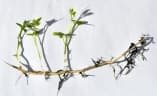
Gynostemma pentaphyllum
Gynostemma pentaphyllum
Safety & Hazards
None known
Cultivation Details
Gynostemma pentaphyllum is not cold hardy outside the warmer regions of the temperate zone, being able to tolerate occasional short-lived temperatures down to between -5 and -10°c[1]. A problematic crop outdoors in cooler regions of the temperate zone, it can be grown successfully as an annual in a greenhouse but requires a long hot summer if it is to do well outdoors. Requires a rich well-drained but moisture-retentive soil in a warm sheltered position in partial shade[2]. Plants tend to be annuals or short-lived perennials[2]. A climbing plant, attaching itself to supports by means of tendrils[2]. Dioecious, male and female plants must be grown if seed is required. Some plants might be monoecious[1].
Propagation
Pre-soak the seed for 24 hours in warm water and then sow it in spring in a rich compost in a greenhouse, placing 2 - 3 seeds per pot. Thin the seedlings to the strongest in each pot and grow the plants on fast. Plant them out after the last expected frosts and protect them with a frame or cloche until they are growing away well. Cite as: Temperate Plants Database, Ken Fern. temperate.theferns.info. 2026-02-21. <temperate.theferns.info/plant/Gynostemma+pentaphyllum>
Pollinators
Insects
References
- [1]The New RHS Dictionary of Gardening. 1992. — Huxley. A. · MacMillan Press · 1992 · ISBN 0-333-47494-5 ↩︎Excellent and very comprehensive, though it contains a number of silly mistakes. Readable yet also very detailed.
- [2]Encyclopaedia of Herbs and their Uses. — Bown. D. · Dorling Kindersley, London. · 1995 · ISBN 0-7513-020-31 ↩︎A very well presented and informative book on herbs from around the globe. Plenty in it for both the casual reader and the serious student. Just one main quibble is the silly way of having two separate entries for each plant.
- [3]Flora of Japan. (English translation) — Ohwi. G. · Smithsonian Institution · 1965 · ISBN - ↩︎The standard work. Brilliant, but not for the casual reader.
- [4]Flora of Japan — http://www.foj.info ↩︎An on-line version of the flora - an excellent resource.
- [5]Flora of China — Missouri Botanical Garden Press; St. Louis. · 1994 · http://flora.huh.harvard.edu/china/ ↩︎An excellent, comprehensive resource in 25 volumes. In addition to the botanical information the flora also gives basic information on habitat and some uses. An on-line version is also available.
- [6]Tanaka's Cyclopedia of Edible Plants of the World. — Tanaka. T. & Nakao S. · Keigaku Publishing; Tokyo · 1976 · ISBN - ↩︎The most comprehensive list of edible plants I've come across. Only the briefest entry for each species, though, and some of the entries are more than a little dubious. Not for the casual reader.
- [7]Plants for Human Consumption. — Kunkel. G. · Koeltz Scientific Books · 1984 · ISBN 3874292169 ↩︎An excellent book for the dedicated. A comprehensive listing of Latin names with a brief list of edible parts.
- [8]Cornucopia - A Source Book of Edible Plants. — Facciola. S. · Kampong Publications · 1990 · ISBN 0-9628087-0-9 ↩︎Excellent. Contains a very wide range of conventional and unconventional food plants (including tropical) and where they can be obtained (mainly N. American nurseries but also research institutes and a lot of other nurseries from around the world.