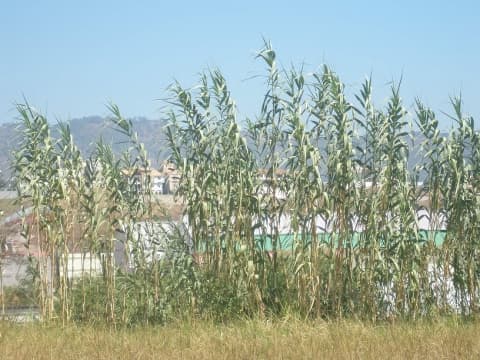
Gynerium sagittatum
Gynerium sagittatum
Safety & Hazards
None known
Cultivation Details
An aquatic plant; it grows best in a moisture-retentive, fertile, humus-rich soil, or in in shallow water, and a position in full sun[1]. Plants can produce large lateral runners which may extend for considerable distances[2]. Horizontal runners or rhizomes, both surface or underground, are constantly active and establish new plants or clumps as far as 20 metres from the parent plant[3]. If not controlled, the plant slowly invades wet bottomland pastures and eliminates forage plants. Periodic mowing appears to be adequate for control of advancing clumps[3]. Growth of uva grass is rapid. Nursery seedlings reached heights of 20, 30 Title Butterflies and Moths in Britain and Europe. Publication Author Carter D. Publisher Pan Year 1982 ISBN 0-330-26642-x Description An excellent book on Lepidoptera, it also lists their favourite food plants. , and 50 cm after 1, 2 Title Sturtevant's Edible Plants of the World. Publication Author Hedrick. U. P. Publisher Dover Publications Year 1972 ISBN 0-486-20459-6 Description Lots of entries, quite a lot of information in most entries and references. , and 4 months. How long seedlings take to reach maturity and how rapidly suckers grow is unknown. Theoretically, baring catastrophes and invasion and shading by trees, individual plants can endure indefinitely. Culms of Amazon Basin plants produced close to 200 leaves during their lifetimes, having from 19 to 28 living leaves at a time. Unbranched culms die after flowering, but only the branches of branched culms die[3]. A dioecious species, both male and female forms need to be grown if seed is required.
Propagation
Seed - Division of the rhizomes. Cite as: Tropical Plants Database, Ken Fern. tropical.theferns.info. 2026-02-20. <tropical.theferns.info/viewtropical.php?id=Gynerium+sagittatum>
Pollinators
Wind
References
- [1]The New RHS Dictionary of Gardening. 1992. — Huxley. A. · MacMillan Press · 1992 · ISBN 0-333-47494-5 ↩︎Excellent and very comprehensive, though it contains a number of silly mistakes. Readable yet also very detailed.
- [2]Flora of Barro Colorado Island — Croat. Thomas B. · Stanford University Press · 1978 · http://biogeodb.stri.si.edu/bioinformatics/croat/home · ISBN 0-8047-0950-5 ↩︎A very good flora of an area in Panama. Written some years ago, so some of the names have been changed. The book is out of print, but the whole flora is now available on the web.
- [3]Wildland Shrubs of the United States and its Territories: Thamnic Descriptions — Francis J.K. (Editor) · USDA; Forest Service International Institute of Tropical Forestr · 2000 · http://www.fs.fed.us/global/iitf/wildland_shrubs.htm ↩︎An excellent series of papers, in PDF format, from various authors giving quite detailed information on a range of shrubs growing in the United States and its Territories. It can be downloaded from the Internet.
- [4]Mansfeld's Database of Agricultural and Horticultural Plants — http://mansfeld.ipk-gatersleben.de/pls/htmldb_pgrc/f?p=185:3:4292127278597336 ↩︎Terse details of a huge range of useful plants.
- [5]Flora of Guatemala — Standley P.C. & J. A. Steyermark · 1946 - 1976 · http://www.archive.org/ ↩︎A superb reference, though somewhat dated. Gives lots of plant uses as well as information on plant habit and habitat. The entire flora (13 volumes) can now be downloaded from http://www.archive.org/
- [6]Medicinal Plants of the Guianas — DeFilipps, R. A.; Maina, S. L.; & Crepin, J. · Smithsonian Museum · http://botany.si.edu/bdg/medicinal/index.html ↩︎A down-loadable PDF document of a book in pre-publication awaiting illustration. An excellent, if rather terse, guide to the traditional medicinal uses of the plants of the region
- [7]Dictionary of Economic Plants. — Uphof. J. C. Th. · Weinheim · 1959 · ISBN - ↩︎An excellent and very comprehensive guide but it only gives very short descriptions of the uses without any details of how to utilize the plants. Not for the casual reader.
- [8]Useful Plants of the Siona and Secoya Indians of Eastern Ecuador. — Vickers W.T.; Plowman T. · Field Museum of Natural History; USA. · 1984 · http://www.biodiversitylibrary.org · ISBN 0015 - 0746 ↩︎Very terse, but it gives the uses of a large number of species. It can be downloaded from the Internet.