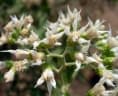
Gymnanthemum amygdalinum
Gymnanthemum amygdalinum
Safety & Hazards
None known
Cultivation Details
A plant of the tropics, where it is found at elevations from 600 - 2,800 metres. It grows best in areas where annual daytime temperatures are within the range 20 - 26°c, but can tolerate 16 - 35°c[1]. It prefers a mean annual rainfall in the range 750 - 2,000mm, but tolerates 600 - 2,400mm[1]. Requires a position in full sun[2]. Succeeds on most soil types, though it grows best in well-drained, humus-rich soils[2, 1]. Plants prefer a moist environment, though they are fairly drought tolerant once established[2]. Prefers a pH in the range 5.5 - 7, tolerating 5 - 7.5[1]. Plants can be coppiced[3]. Cultivated forms have been selected that are less bitter than the wild plant[2]. Flowering is induced by short days[2].
Propagation
Seed - takes 2 - 3 weeks to germinate[2]. Cuttings of mature wood. Cite as: Tropical Plants Database, Ken Fern. tropical.theferns.info. 2026-02-20. <tropical.theferns.info/viewtropical.php?id=Gymnanthemum+amygdalinum>
Pollinators
Data unavailable
References
- [1]Ecocrop — http://ecocrop.fao.org/ecocrop/srv/en/home ↩︎Basic information on a wide range of useful plants, plus details of environmental needs where available.
- [2]Protabase - Plant Resources of Tropical Africa. — http://www.prota.org ↩︎An excellent on-line database with detailed information on over 3,200 species of useful plants of Africa.
- [3]World Agroforesty Centre — http://www.worldagroforestry.org/ ↩︎An excellent online database of a huge range of trees giving very good information on each plant - its uses, ecology, identity, propagation, pests etc.
- [4]Cornucopia II — Facciola. S. · Kampong Publications, California. · 1998 · ISBN 0-9628087-2-5 ↩︎The second edition of an excellent guide to the edible uses of plants, though it does not give any details of cultivation etc.