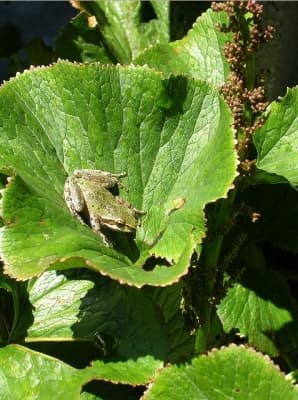
Gunnera perpensa
Gunnera perpensa
Safety & Hazards
None known
Cultivation Details
Although it can grow at quite high elevations in the tropics, this species cannot tolerate frost and even when growing in warm protective areas it will die back for the coldest months of the year[1]. Grows in the wild in wet soil or shallow water[1]. An obligate wetland plant, it grows in shallow water around the edge of pools in marshy areas or along streams[1]. The top part of the inflorescence is male, the bottom is female and the middle is hermaphrodite[2]. Members of this genus are rarely if ever troubled by browsing deer[3]. It is believed that species of the genus Gunnera have existed for about 95 million years[1]. Gunnera species are unique in the plant realm through having a symbiotic relationship with a cyanobacteria (Nostoc punctiforme and others). This relationship provides nitrogen to the Gunnera and carbon to the cyanobacteria[4]. The genus Nostoc is cosmopolitan and common, so it is likely to be naturally present in the wet habitats in which Gunnera grows[5, 4].
Propagation
Seed - best sown as soon as soon as it is ripe in the autumn in a sandy mix in a cold frame[2]. The seed can also be sown in the spring[6]. When they are large enough to handle, prick the seedlings out into individual pots and grow them on in the greenhouse for at least their first winter. Plant them out into their permanent positions in late spring or early summer, after the last expected frosts. Division as new growth commences in the spring[2]. Larger clumps can be replanted direct into their permanent positions, though it is best to pot up smaller clumps and grow them on in a cold frame until they are rooting well. Plant them out in the spring. Cite as: Temperate Plants Database, Ken Fern. temperate.theferns.info. 2026-02-21. <temperate.theferns.info/plant/Gunnera+perpensa>
Pollinators
Wind
References
- [1]PlantZAfrica.com — http://www.plantzafrica.com ↩︎An excellent site giving detailed descriptions and uses of many S. African plants.
- [2]The New RHS Dictionary of Gardening. 1992. — Huxley. A. · MacMillan Press · 1992 · ISBN 0-333-47494-5 ↩︎Excellent and very comprehensive, though it contains a number of silly mistakes. Readable yet also very detailed.
- [3]Perennial Garden Plants — Thomas. G. S. · J. M. Dent & Sons, London. · 1990 · ISBN 0 460 86048 8 ↩︎A concise guide to a wide range of perennials. Lots of cultivation guides, very little on plant uses.
- [4]Gunneraceae — Mora-Osejo L.E., Pabón-Mora N. & González F. · The New York Botanical Garden Press; New York · 2011 · ISBN 978-0-89327-508-2 ↩︎
- [5]Invasive Species Compendium — http://www.cabi.org ↩︎An immense resource - in depth information on over 900 species of invasive plants (it also has information on animals, fungi etc).
- [6]The RHS Gardener's Encyclopedia of Plants and Flowers — Brickell. C. · Dorling Kindersley Publishers Ltd. · 1990 · ISBN 0-86318-386-7 ↩︎Excellent range of photographs, some cultivation details but very little information on plant uses.
- [7]Flora Zambesiaca — http://apps.kew.org/efloras/fz/intro.html ↩︎An excellent online flora of plants from the Zambezi River basin. It lists a number of the plant uses as well as the habitats and botanical descriptions of the plants.
- [8]Dictionary of Economic Plants. — Uphof. J. C. Th. · Weinheim · 1959 · ISBN - ↩︎An excellent and very comprehensive guide but it only gives very short descriptions of the uses without any details of how to utilize the plants. Not for the casual reader.
- [9]IUCN Red List of Threatened Species — http://www.iucnredlist.org/ ↩︎A list of plants under threat and facing possible extinction, usually with brief details of the threats and information on habitat.
- [10]Mansfeld's Database of Agricultural and Horticultural Plants — http://mansfeld.ipk-gatersleben.de/pls/htmldb_pgrc/f?p=185:3:4292127278597336 ↩︎Terse details of a huge range of useful plants.
- [11]African Flowering Plants Database — Conservatoire et Jardin Botaniques. · http://www.ville-ge.ch/musinfo/bd/cjb/africa/recherche.php ↩︎Contains information on over 150,000 plant names (including synonyms) giving a description and habitat, plus a distribution map.
- [12]Plants for Human Consumption. — Kunkel. G. · Koeltz Scientific Books · 1984 · ISBN 3874292169 ↩︎An excellent book for the dedicated. A comprehensive listing of Latin names with a brief list of edible parts.
- [13]Swaziland's Flora - siSwati Names and Uses — Chris Long · 2005 · http://www.sntc.org.sz/flora/chrislong.asp ↩︎A basic, but very long, list of names and uses.
- [14]BoDD (Botanical Dermatology Database) — http://bodd.cf.ac.uk/ ↩︎Brief notes on a very wide range of plants that have reports of causing harm to the skin.