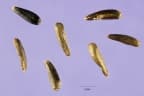
Guizotia abyssinica
Guizotia abyssinica
Safety & Hazards
None known
Cultivation Details
Niger seed is a short-day plant adapted to the cool tropical environment of the middle elevations as well as the highland regions of eastern Africa, but it has also adapted to the tropical and subtropical lowlandsin India and to temperate conditions in Europe[1]. It is reported to tolerate an annual precipitation of 660 - 1790mm, and an annual temperature range of 13.6 - 27.5°c[2]. At temperatures above 30°c, the rates of growing and flowering are adversely affected and maturity is hastened. Night temperatures should not fall below 2°c[1]. An easily grown plant, it succeeds in any rich soil[3]. The plant is adapted to a wide range of soils, from sandy to heavy, growth being poor on light sandy or gravelly soils[2]. Niger is often cultivated on very poor acid soils, on hilly slopes, where fertility is low due to leaching and washing away of the plant nutrients by erosion[2]. Succeeds in soils with a pH in the range of 5.5 - 7.5[2]. The first side-shoots are formed when plants have 6 - 8 leaves and are about 30cm tall[1]. Most types of niger seed are short-day plants with only few day-length-insensitive individual plants. The critical day length is about 12 hours[1]. Under short days, flowering starts about 60 days after germination. Photoperiod sensitivity is stronger in Ethiopian than in Indian cultivars, while in Indian plants induction of flowering probably takes place at an earlier stage of evelopment[1].. Short days 1 month after sowing gave full induction in Indian material but no induction in Ethiopian plants. In the latter, induction took place 55 - 75 days after sowing[1]. Because the heads of niger seed mature over a period of time and shattering can reduce the yield by as much as 25%, the time of harvesting has to be established carefully. The best time for harvesting is just before the crop matures, about 3 weeks after 50% floret drop. At this stage, when the top leaves start turning from green to yellow, the fruits are yellow-brown and their moisture content is about 45%[1]. Average seed yields in India range from 100 - 200 kg/ha when grown with ragi, and 300 - 400 kg/ha when grown in pure stands[2]. In Kenya, monocultural yields average 600 kg/ha[2]. Seed yields of 1,000 to 1,200 kg/ha have been obtained on fertile Himalayan soils[2]. Oil content of the seed varies from 30 - 50%, reaching a maximum at 45 days after flower-opening[4]. Oil yields range about 235 kg/ha[2]. The flowers are very attractive to bees[2].
Propagation
Seed - sow spring in situ and only just cover the seed. Make sure the soil does not dry out because this would delay germination. In warm weather, germination should take place within 3 - 4 days of sowing the seed. When sowing larger areas, the seed may be broadcast at rate of 10 kg/ha or sown in rows 40 to 50 cm apart at rate of 5 kg/ha[2]. Cite as: Temperate Plants Database, Ken Fern. temperate.theferns.info. 2026-02-21. <temperate.theferns.info/plant/Guizotia+abyssinica>
Pollinators
Bees, Insects
References
- [1]Protabase - Plant Resources of Tropical Africa. — http://www.prota.org ↩︎An excellent on-line database with detailed information on over 3,200 species of useful plants of Africa.
- [2]Handbook of Energy Crops — Duke. J. · - · 1983 · https://hort.purdue.edu/newcrop/duke_energy/dukeindex.html · ISBN - ↩︎Published only on the Internet, excellent information on a wide range of both temperate and tropical plants.
- [3]RHS Dictionary of Plants plus Supplement. 1956 — F. Chittendon. · Oxford University Press · 1951 · ISBN - ↩︎Comprehensive listing of species and how to grow them. Somewhat outdated, it has been replaced in 1992 by a new dictionary (see [ 200 ]).
- [4]The Useful Plants of West Tropical Africa. — Burkil. H. M. · Royal Botanic Gardens; Kew. · 1985 - 2004 ↩︎Brief descriptions and details of the uses of over 4,000 plants. A superb, if terse, resource, it is also available electronically on the Web - see http://www.aluka.org/
- [5]Flora of the British Isles. — Clapham, Tutin and Warburg. · Cambridge University Press · 1962 · ISBN - ↩︎A very comprehensive flora, the standard reference book but it has no pictures.
- [6]The New RHS Dictionary of Gardening. 1992. — Huxley. A. · MacMillan Press · 1992 · ISBN 0-333-47494-5 ↩︎Excellent and very comprehensive, though it contains a number of silly mistakes. Readable yet also very detailed.
- [7]Sturtevant's Edible Plants of the World. — Hedrick. U. P. · Dover Publications · 1972 · ISBN 0-486-20459-6 ↩︎Lots of entries, quite a lot of information in most entries and references.
- [8]Dictionary of Economic Plants. — Uphof. J. C. Th. · Weinheim · 1959 · ISBN - ↩︎An excellent and very comprehensive guide but it only gives very short descriptions of the uses without any details of how to utilize the plants. Not for the casual reader.
- [9]Flowers of the Himalayas. — Polunin. O. and Stainton. A. · Oxford Universtiy Press · 1984 · ISBN - ↩︎A very readable and good pocket guide (if you have a very large pocket!) to many of the wild plants in the Himalayas. Gives many examples of plant uses.
- [10]A Dictionary of Plants Used by Man. — Usher. G. · Constable · 1974 · ISBN 0094579202 ↩︎Forget the sexist title, this is one of the best books on the subject. Lists a very extensive range of useful plants from around the world with very brief details of the uses. Not for the casual reader.
- [11]Alternative Foods. — Sholto-Douglas. J. ↩︎Not very comprehensive, it seems more or less like a copy of earlier writings with little added.
- [12]Plants for Human Consumption. — Kunkel. G. · Koeltz Scientific Books · 1984 · ISBN 3874292169 ↩︎An excellent book for the dedicated. A comprehensive listing of Latin names with a brief list of edible parts.
- [13]Cornucopia - A Source Book of Edible Plants. — Facciola. S. · Kampong Publications · 1990 · ISBN 0-9628087-0-9 ↩︎Excellent. Contains a very wide range of conventional and unconventional food plants (including tropical) and where they can be obtained (mainly N. American nurseries but also research institutes and a lot of other nurseries from around the world.
- [14]Plants Consumed by Man. — Brouk. B. · Academic Press · 1975 · ISBN 0-12-136450-x ↩︎Readable but not very comprehensive.
- [15]Glossary of Indian Medicinal Plants (Including the Supplement). — Chopra. R. N., Nayar. S. L. and Chopra. I. C. · Council of Scientific and Industrial Research, New Delhi. · 1986 · ISBN - ↩︎Very terse details of medicinal uses of plants with a wide range of references and details of research into the plants chemistry. Not for the casual reader.
- [16]Medicinal Plants of Nepal — Dept. of Medicinal Plants. Nepal. · 1993 · ISBN - ↩︎Terse details of the medicinal properties of Nepalese plants, including cultivated species and a few imported herbs.
- [17]Plants and People of Nepal — Manandhar. N. P. · Timber Press. Oregon. · 2002 · ISBN 0-88192-527-6 ↩︎Excellent book, covering over 1,500 species of useful plants from Nepal together with information on the geography and peoples of Nepal. Good descriptions of the plants with terse notes on their uses.
- [18]Economic Botany. — Hill. A. F. · The Maple Press · 1952 · ISBN - ↩︎Not very comprehensive, but it is quite readable and goes into some detail about the plants it does cover.
- [19]Plants for Man. — Schery. R. W. ↩︎Fairly readable but not very comprehensive. Deals with plants from around the world.
- [20]Fruits of the Earth. — Bianchini. F., Corbetta. F. and Pistoia. M. ↩︎Lovely pictures, a very readable book.