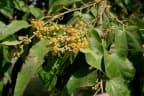
Guazuma ulmifolia
Guazuma ulmifolia
Safety & Hazards
None known
Cultivation Details
A plant of the dry to moist tropics, where it is found at elevations up to 1,200 metres. It grows best in areas where annual daytime temperatures are within the range 22 - 32°c, but can tolerate 10 - 36°c[1]. It prefers a mean annual rainfall in the range 700 - 1,500mm, but tolerates 500 - 1,700mm[1]. The plant can tolerate up to 2,500mm annual rainfall[2, 3]. Prefers a sunny position[2, 3]. The plant is widely adapted, found growing in both alluvial and clay soils[2]. Succeeds on a variety of soils but is most common where pH is higher than 5.5[3]. Prefers a pH in the range 6 - 7, tolerating .5 - 7.5[1]. The plant can escape from cultivation and become a weed tree in areas outside its native range[1]. A fast-growing tree[4]. The tree can flower all year round in the more equatorial part of its range[3].
Propagation
Seed - requires scarification before planting[2]. Pour boiling water over the seeds, let them soak for 30 seconds and then drain[2]. With fresh seed, germination occurs in 7 - 14 days at a rate of 60 - 80%[2]. Seedlings are ready for out-planting when they reach a height of 30 - 40cm (about 15 weeks)[2]. The plant can also be established by direct seeding[2]. Cuttings[2]. Cite as: Tropical Plants Database, Ken Fern. tropical.theferns.info. 2026-02-20. <tropical.theferns.info/viewtropical.php?id=Guazuma+ulmifolia>
Pollinators
Data unavailable
References
- [1]Ecocrop — http://ecocrop.fao.org/ecocrop/srv/en/home ↩︎Basic information on a wide range of useful plants, plus details of environmental needs where available.
- [2]World Agroforesty Centre — http://www.worldagroforestry.org/ ↩︎An excellent online database of a huge range of trees giving very good information on each plant - its uses, ecology, identity, propagation, pests etc.
- [3]Seed Leaflets — Various · Forest & Landscape. Denmark · http://en.sl.life.ku.dk/Publikationer/Udgivelser/PopulaerPublikationer.aspx?katid={D28373CC-6EF3-4EF8-B097-6D83FABF209E}&serieid={9F1C3DB1-6E7B-4CF1-AF53-F480B0CB40EF}&sort=title ↩︎A series of leaflets, jointly produced by the University of Copenhagen and the Royal Botanic Gardens at Kew, focussing on seed information for a number species, but also giving a lot of other information about each plant.
- [4]Brazilian Trees. Volume 1. 4th Edition. — Lorenzi. H. · Instituto Plantarum De Estudos Da Flora; Brazil. · 2002 · ISBN 85-86714-17-8 ↩︎Information on 350 species of Brazilian trees. Stunning photographs of each species, brief details on the plant, its uses and how to grow it from seed. A superb work, with the minor irritation that the translation from Portuguese is not of the best.
- [5]Raintree Nutrition - Tropical Plant Database — http://www.rain-tree.com/plants.htm ↩︎Detailed information on the medicinal uses of more than two hundred rainforest plants, mainly from S. America, with basic descriptions of the plants, their other uses etc.
- [6]Mansfeld's Database of Agricultural and Horticultural Plants — http://mansfeld.ipk-gatersleben.de/pls/htmldb_pgrc/f?p=185:3:4292127278597336 ↩︎Terse details of a huge range of useful plants.
- [7]IUCN Red List of Threatened Species — http://www.iucnredlist.org/ ↩︎A list of plants under threat and facing possible extinction, usually with brief details of the threats and information on habitat.
- [8]Rio Mayo Plants - A study of the flora and vegetation of the valley of the Rio Mayo, Sonora — Gentry H.S. · Carnegie Institution of Washington; Washington DC · 1942 ↩︎One of my favourite authors on native plants, often including their uses. This is an excellent example with lots of information, even though the book is 80 years old.
- [9]Cornucopia II — Facciola. S. · Kampong Publications, California. · 1998 · ISBN 0-9628087-2-5 ↩︎The second edition of an excellent guide to the edible uses of plants, though it does not give any details of cultivation etc.
- [10]Medicinal Plants of Brazil — Mors W.B.; Rizzini C.T.; Pereira N.A. · Reference Publications; Michigan. · 2000 · ISBN 0-917256-42-5 ↩︎An extremely concise book, listing approximately 1,500 species and varieties of plants with their botanical name, common name in Brazil, regions in Brazil where the plant is found, a brief list of uses and any medically active compounds in the plant.
- [11]CosIng — http://ec.europa.eu/growth/tools-databases/cosing/ ↩︎CosIng is the European Commission database for information on cosmetic substances and ingredients.
- [12]Dictionary of Economic Plants. — Uphof. J. C. Th. · Weinheim · 1959 · ISBN - ↩︎An excellent and very comprehensive guide but it only gives very short descriptions of the uses without any details of how to utilize the plants. Not for the casual reader.
- [13]Technical Information on 134 Species of Bolivian Woods — USDA Forest Service -- Forest Products Lab · USDA Forest Service · http://www2.fpl.fs.fed.us/publications/ ↩︎A PDF file, available for download. Exactly what the title says, brief and to the point.