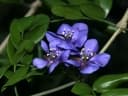
Guaiacum sanctum
Guaiacum sanctum
Safety & Hazards
None known
Cultivation Details
A plant of the lowland moist tropics, where it is found at elevations up to 100 metres. It grows best in areas where annual daytime temperatures are within the range 22 - 28°c, but can tolerate 20 - 34°c[1]. It can be killed by temperatures of 1°c or lower[1]. It prefers a mean annual rainfall in the range 700 - 1,500mm, but tolerates 500 - 2,000mm[1]. Can be grown in full sun or partial shade on a wide variety of soils, including alkaline[2]. Plants will easily tolerate wet or dry soil, wind, and salt, making it an ideal choice especially for seaside plantings[2]. It grows well in shallow soils, particularly in limestone areas, well-drained low areas, low foothills subject to hot dry winds, and rocky limestone regions[3]. Prefers a pH in the range 5 - 7.5, tolerating 4.5 - 8[1]. Young trees commence flowering when about 6 - 8 years old[3].
Propagation
Seed - best sown as soon as ripe. Immersing them in running water (at 20 °c) for 24 hours before sowing improves germination[3]. The seed is sown at a depth of 1 cm in containers of sandy compost. Germination begins 6 - 8 days after sowing and ends in 16 - 20 days[3]. Fresh seeds have 40 - 60% germination in nurseries[3]. When the seedlings are 6 cm tall, they are transferred to nursery bags. Seedlings are ready for outplanting 1 year after sowing, when they reach 30 - 40 cm in height[3]. Seeds can be stored for 1 month at 5 - 8 °C. They lose viability in less than 1 month if stored at ambient temperature and humidity[3]. Fruits must be collected from the soil very early in the morning to avoid seed predation by rodents[3]. The fruits are placed on the floor and dried for 7 days in the shade; later the fruit pericarp is removed with running water to extract the seeds. The seeds are then dried in the shade and stored in hermetic containers. Seeds average 20,000 per kg[3]. Cite as: Tropical Plants Database, Ken Fern. tropical.theferns.info. 2026-02-20. <tropical.theferns.info/viewtropical.php?id=Guaiacum+sanctum>
Pollinators
Data unavailable
References
- [1]Ecocrop — http://ecocrop.fao.org/ecocrop/srv/en/home ↩︎Basic information on a wide range of useful plants, plus details of environmental needs where available.
- [2]Institute of Food and Agricultural Sciences, University of Florida — University of Florida · http://hort.ifas.ufl.edu/shrubs/ ↩︎PDF fact sheets on over 500 shrubs.
- [3]Tropical Tree Seed Manual — Vosso. J. Editor. · USDA Forest Service. · 2002 · http://www.rngr.net/Publications/ttsm ↩︎An extremely good guide, it can also be downloaded in its entirety from the address shown above.
- [4]Tropical and Subtropical Trees - A Worldwide Encyclopaedic Guide. — Barwick. M. · Thames & Hudson, London · 2004 · ISBN 0-500-51181-0 ↩︎A superb book, very concise and well written, giving a wealth of information on 400 or more species including descriptions, habitat, cultivation details and plant uses. A wealth of colour photographs bring each plant vividly to life.
- [5]IUCN Red List of Threatened Species — http://www.iucnredlist.org/ ↩︎A list of plants under threat and facing possible extinction, usually with brief details of the threats and information on habitat.
- [6]Timber Trees of Meso America. — UNEP · 2005 · http://www.unep-wcmc.org/forest/timber/workshops/reports/MA2005/Annex%202.pdf ↩︎A PDF document, published on the internet. Detailed reports on about 30 species of timber trees from Central America.
- [7]Dictionary of Economic Plants. — Uphof. J. C. Th. · Weinheim · 1959 · ISBN - ↩︎An excellent and very comprehensive guide but it only gives very short descriptions of the uses without any details of how to utilize the plants. Not for the casual reader.