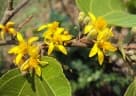
Grewia tiliifolia
Grewia tiliifolia
Safety & Hazards
None known
Cultivation Details
A plant of the moist, lowland tropics and subtropics, where it is found at elevations up to 900 metres. It grows best in areas where annual daytime temperatures are within the range 30 - 42°c, but can tolerate 7 - 47°c[1]. Mature plants can be killed by temperatures of -5°c or lower, but young growth will be severely damaged at -1°c[1]. It prefers a mean annual rainfall in the range 1,000 - 2,500mm, but tolerates 750 - 4,000mm[1]. Succeeds in full sun and light shade[1]. Succeeds in a range of well-drained soils[1]. Prefers a pH in the range 6 - 6.5, tolerating 5.5 - 7[1].
Propagation
Seed - we have no specific information for this species but seed of this genus is generally best sown as soon as it is ripe. Stored seed has a hard seedcoat and may benefit from scarification before sowing in order to speed up and improve germination. This can usually be done by pouring a small amount of nearly boiling water on the seeds (being careful not to cook them!), allowing the mix to cool somewhat and then leaving it in a warm place to soak for 12 - 24 hours. Sow the seeds in situ or in a nursery seedbed or trays - do not allow the compost to become dry. Germination and early growth are usually quite quick. Cuttings - best taken with a heel. Cite as: Tropical Plants Database, Ken Fern. tropical.theferns.info. 2026-02-20. <tropical.theferns.info/viewtropical.php?id=Grewia+tiliifolia>
Pollinators
Data unavailable
References
- [1]Ecocrop — http://ecocrop.fao.org/ecocrop/srv/en/home ↩︎Basic information on a wide range of useful plants, plus details of environmental needs where available.
- [2]Flowers of India — http://www.flowersofindia.net/ ↩︎A wed site of native Indian plants, plus cultivated and naturalized species. It has good quality photos and terse details on more than 3,000 species and cultivars.
- [3]Flora of China — Missouri Botanical Garden Press; St. Louis. · 1994 · http://flora.huh.harvard.edu/china/ ↩︎An excellent, comprehensive resource in 25 volumes. In addition to the botanical information the flora also gives basic information on habitat and some uses. An on-line version is also available.
- [4]A Manual of Indian Timbers. — Gamble. J. S. · Bishen Singh Mahendra Pal Singh · 1972 · ISBN - ↩︎First written in the 19th century, but still a classic, giving a lot of information on the uses and habitats of Indian trees. Not for the casual reader.
- [5]Economic Products of India. Volume 1. — Watt. G. · Government of India: Calcutta. · 1883 ↩︎Although over 100 years old, it still contains a wealth of information on useful plants. Many of the botanical names have been changed since then, so you have to check for up to date names. The book can be downloaded from the Internet.
- [6]Antioxidant activity of selected lesser known edible fruits from western ghats of India — Karuppusamy S.; Muthuraja G.; Rajasekaran K.M. · 2011 ↩︎
- [7]Phytochemical and Pharmacological Properties of the Genus Grewia; A Review — Goyal P.K. · 2012 · ISBN 0975-1491 ↩︎