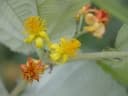
Grewia asiatica
Grewia asiatica
Safety & Hazards
None known
Cultivation Details
The plant grows in both tropical and subtropical climates but will tolerate other climates, except at high altitude; however, it does best in regions having distinct summer and winter seasons[1]. In India, it grows well up to an elevation of 1,500 metres. The temperature range for growth is reported to be 10 - 44°c with the optimum between 23 - 34°c[1]. The plant tolerates short periods of light frosts[1]. Mature plants, when dormant, can tolerate occasional temperatures down to -5°c, although new growth can be killed at 0°c[2]. The annual rainfall range for growth is reported to be 1,250 - 4,000mm with the optimum between 2,300 - 2,900mm[1]. An easily grown plant, tolerant of a range of soils and conditions[3]. Prefers a pH in the range 6 - 7.5, tolerating 5.5 - 8[2]. Established plants are drought resistant[3, 1]. When grown commercially, plants are cut back hard annually to encourage the growth of new shoots[3]. Flowers develop only on the new shoots of the current growing season. The period between flowering and fruiting maturity is 45 - 55 days[1]. Fruit yields are improved if the plant is cut back to the ground each year, thus encouraging plenty of new growth upon which the fruit is produced[2]. Phalsa begins to bear fruit after only 2 years, but does not produce marketable fruit until the 3rd year[1]. The annual yield is 3 - 5 kg/plant or 4.5 - 6 tonnes per hectare[1]. In the absence of a prominent change of seasons the plant does not shed its leaves, flowers erratically throughout the year and fruits poorly[1].
Propagation
Seed - does not require any pre-sowing treatment. Fresh seeds are reported to give minimum germination; they take 15-20 days[1]. Layering Cuttings in open ground give poor results, but under closed conditions, with hormone treatment, they are better[1]. Cite as: Tropical Plants Database, Ken Fern. tropical.theferns.info. 2026-02-20. <tropical.theferns.info/viewtropical.php?id=Grewia+asiatica>
Pollinators
Data unavailable
References
- [1]World Agroforesty Centre — http://www.worldagroforestry.org/ ↩︎An excellent online database of a huge range of trees giving very good information on each plant - its uses, ecology, identity, propagation, pests etc.
- [2]Ecocrop — http://ecocrop.fao.org/ecocrop/srv/en/home ↩︎Basic information on a wide range of useful plants, plus details of environmental needs where available.
- [3]The New RHS Dictionary of Gardening. 1992. — Huxley. A. · MacMillan Press · 1992 · ISBN 0-333-47494-5 ↩︎Excellent and very comprehensive, though it contains a number of silly mistakes. Readable yet also very detailed.
- [4]Thai Forest Bulletin (Botany) No. 16 — The Forest Herbarium; Bangkok. · 1986 · ISBN 0495-3843 ↩︎A botanical journal, publishing papers on taxonomy (especially vascular plants), nomenclature, phylogeny, systematics, plant geography, and floristics; also morphology, palynology, cytotaxonomy, chemotaxonomy, anatomy and other relevant disciplines.
- [5]Flora of Pakistan — http://www.efloras.org ↩︎As of 2006, there is not much information on habitats available, but it is being developed and promises to be an excellent resource.
- [6]Plant Resources of Southeast Asia — http://proseanet.org/ ↩︎Lots of information on the uses of the plants of SE Asia.
- [7]IUCN Red List of Threatened Species — http://www.iucnredlist.org/ ↩︎A list of plants under threat and facing possible extinction, usually with brief details of the threats and information on habitat.
- [8]Plants and People of Nepal — Manandhar. N. P. · Timber Press. Oregon. · 2002 · ISBN 0-88192-527-6 ↩︎Excellent book, covering over 1,500 species of useful plants from Nepal together with information on the geography and peoples of Nepal. Good descriptions of the plants with terse notes on their uses.
- [9]Cornucopia II — Facciola. S. · Kampong Publications, California. · 1998 · ISBN 0-9628087-2-5 ↩︎The second edition of an excellent guide to the edible uses of plants, though it does not give any details of cultivation etc.
- [10]Phytochemical and Pharmacological Properties of the Genus Grewia; A Review — Goyal P.K. · 2012 · ISBN 0975-1491 ↩︎
- [11]Ethnobotanical Studies of Useful Trees of District Kotli, Azad Jammu and Kashmir — Muhammad Ajaib & Zaheer-Ud-Din Khan · 2014 · ISBN 2313-206X ↩︎
- [12]Economic Products of India. Volume 1. — Watt. G. · Government of India: Calcutta. · 1883 ↩︎Although over 100 years old, it still contains a wealth of information on useful plants. Many of the botanical names have been changed since then, so you have to check for up to date names. The book can be downloaded from the Internet.