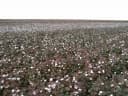
Gossypium hirsutum
Gossypium hirsutum
Safety & Hazards
Some forms of this plant contain the toxin gossypol - glandless cultivars are free of this toxin[1].
Cultivation Details
Sea Island cotton can be grown in the dry to moist tropics and subtropics, where it is found at elevations up to 1,250 metres. For commercial production it requires a climate that has a long, hot growing season with abundant moisture, followed by a drier period for harvesting the seed floss[2]. Low temperature increases the production of vegetative branches and extends the cropping period, while high temperature increases the number of fruiting branches and reduces the cropping period. It grows best in areas where annual daytime temperatures are within the range 22 - 36°c, but can tolerate 15 - 42°c[3]. It prefers a mean annual rainfall in the range 750 - 1,200mm, but tolerates 450 - 1,500mm[3]. Prefers a very sunny position in a light, fertile soil[2]. Plants can tolerate a range of well-drained soils, including moderate levels of salt[3]. Prefers a pH in the range 6 - 7.5, tolerating 5 - 9.5[3]. Requires a position sheltered from strong winds[3]. The plant is usually cultivated as an annual, taking 150 - 220 days to mature a crop[3]. Seed-cotton yields vary between 0.8 - 3 tonnes/ha, or 0.2 - 1.1 tonnes/ha of fibre[3].
Propagation
Seed - Cite as: Tropical Plants Database, Ken Fern. tropical.theferns.info. 2026-02-20. <tropical.theferns.info/viewtropical.php?id=Gossypium+hirsutum>
Pollinators
Insects
References
- [1]Cornucopia II — Facciola. S. · Kampong Publications, California. · 1998 · ISBN 0-9628087-2-5 ↩︎The second edition of an excellent guide to the edible uses of plants, though it does not give any details of cultivation etc.
- [2]The New RHS Dictionary of Gardening. 1992. — Huxley. A. · MacMillan Press · 1992 · ISBN 0-333-47494-5 ↩︎Excellent and very comprehensive, though it contains a number of silly mistakes. Readable yet also very detailed.
- [3]Ecocrop — http://ecocrop.fao.org/ecocrop/srv/en/home ↩︎Basic information on a wide range of useful plants, plus details of environmental needs where available.
- [4]Medicinal Plants of the Guianas — DeFilipps, R. A.; Maina, S. L.; & Crepin, J. · Smithsonian Museum · http://botany.si.edu/bdg/medicinal/index.html ↩︎A down-loadable PDF document of a book in pre-publication awaiting illustration. An excellent, if rather terse, guide to the traditional medicinal uses of the plants of the region
- [5]Dictionary of Economic Plants. — Uphof. J. C. Th. · Weinheim · 1959 · ISBN - ↩︎An excellent and very comprehensive guide but it only gives very short descriptions of the uses without any details of how to utilize the plants. Not for the casual reader.
- [6]CosIng — http://ec.europa.eu/growth/tools-databases/cosing/ ↩︎CosIng is the European Commission database for information on cosmetic substances and ingredients.