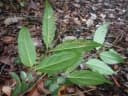
Gnetum africanum
Gnetum africanum
Safety & Hazards
None known
Cultivation Details
A plant of humid, lowland tropical rainforests, being found at elevations from sea level to 1,200 metres[1]. It grows best in areas where the annual rainfall is around 3,000 mm[1]. Succeeds in dappled shade in the woodland. Plants growing in full sun produce thinner leaves which are not so well liked by consumers[1]. The plant tolerates a range of habitats and environmental conditions[2]. Cultivated plants need to be given some support, such as a tree, to grow into[1]. The plant forms two distinct types of stem. Growing up from the base, the stems produce only small, scale-like leaves, and they grow rapidly towards the light. Higher up, side shoots are formed with fully-developed leaves[1]. The plant continues to grow during the dry season and new shoots may develop where the stem has been cut or where side shoots have been removed[1]. New shoots are also formed from rhizomes that spread along the forest floor[1]. Current methods of harvest from wild stands are very destructive[1]. Controlled harvesting, in which only side shoots or parts of stems are collected, allows new shoots to develop where a stem has been cut or where side shoots have been removed[1]. Preliminary observations indicate that 3 - 4 harvests per year are possible, still allowing for substantial regrowth. More frequent harvesting will result in thin leaves that are considered inferior[1]. The first harvest may take place 6 - 9 months after planting. The total lifespan of the plant is estimated at over 10 years[1]. Preliminary observation indicates that in cultivation during the first harvest year the fresh leaf yield may reach 20 t/ha. This may double in subsequent years[1]. Under wild conditions, the plant grows and forms underground tubers or roots that store plant food reserves. These can remain alive for many years when the vegetation and the plant growth above ground are cleared and the soil surface is laid bare[3]. A dioecious species, both male and female forms need to be grown if fruit and seed are required. Female plants are often have stronger stems, and are more vigorous and productive than male plants[1, 4].
Propagation
Seed - difficult to germinate in nursery conditions, though the plants self-sow successfully in the wild[3]. It is assumed that seeds need pre-treatment, such as passing through the intestines of a bird, fruit bat, squirrel or other animal, before they germinate[1]. Seed is normally found only in the tree canopy[1]. Seed collection is thus far from easy, a further reason why the plant is hardly cultivated[1]. Methods of vegetative propagation using leafy stem cuttings have recently been developed. It is recommended that leaf blades of cuttings be trimmed in half[1]. Nursery beds under shade and made of well-decomposed sawdust or fine river sand can be used for propagation[1]. Ectomycorrhizae assist the roots in absorption of nutrients; the most common species reported is Scleroderma sinnamarense. After about 6 weeks the rooted cuttings are transferred to polythene sleeves, bamboo pots or other containers where they remain for a further 2 - 3 months. The soil mixture for these containers consists of 25% sand and some compost, supplemented with forest soil[1]. Field planting, preferably next to a young tree or shrub, takes place at the beginning of the rainy season[1]. Cite as: Tropical Plants Database, Ken Fern. tropical.theferns.info. 2026-02-20. <tropical.theferns.info/viewtropical.php?id=Gnetum+africanum>
Pollinators
Data unavailable
References
- [1]Protabase - Plant Resources of Tropical Africa. — http://www.prota.org ↩︎An excellent on-line database with detailed information on over 3,200 species of useful plants of Africa.
- [2]IUCN Red List of Threatened Species — http://www.iucnredlist.org/ ↩︎A list of plants under threat and facing possible extinction, usually with brief details of the threats and information on habitat.
- [3]Non-wood Forest Products of Central Africa. — Sunderland. T.; Clark. L. & Vantomme. P. · FAO; Rome. · 1999 · http://www.fao.org/docrep/X2161E/x2161e00.htm#TopOfPage ↩︎Papers from a workshop organized by the Food and Agriculture Organization of the United Nations. Downloadable from the FAO website.
- [4]World Agroforesty Centre — http://www.worldagroforestry.org/ ↩︎An excellent online database of a huge range of trees giving very good information on each plant - its uses, ecology, identity, propagation, pests etc.
- [5]The Useful Plants of West Tropical Africa. — Burkil. H. M. · Royal Botanic Gardens; Kew. · 1985 - 2004 ↩︎Brief descriptions and details of the uses of over 4,000 plants. A superb, if terse, resource, it is also available electronically on the Web - see http://www.aluka.org/