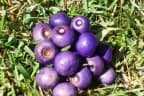
Gmelina leichhardtii
Gmelina leichhardtii
Safety & Hazards
None known
Cultivation Details
A plant of the lowland, moist tropics and subtropics, where it is found at elevations up to 500 metres. It grows best in areas where annual daytime temperatures are within the range 26 - 30°c, but can tolerate 10 - 36°c[1]. Mature plants can be killed by temperatures of -5°c or lower, but new growth will be severely damaged at 0°c[1]. It prefers a mean annual rainfall in the range 1,200 - 1,800mm, but tolerates 1,000 - 2,000mm[1]. Prefers a sunny position, tolerating some shade[1]. Succeeds in a wide range of moderately fertile, well-drained soils[1]. Prefers a pH in the range 5.5 - 6.5, tolerating 5 - 7.5[1]. A moderately fast growing plant[1].
Propagation
Seed - remove the flesh from the seed capsule and leave the capsule in the sun to dry. Hairline cracks will form around a 'trapdoor' in the capsule and the whole capsule can then be sown. The up to 4 seeds in the capsule should germinate rapidly[2]. Cite as: Tropical Plants Database, Ken Fern. tropical.theferns.info. 2026-02-20. <tropical.theferns.info/viewtropical.php?id=Gmelina+leichhardtii>
Pollinators
Data unavailable
References
- [1]Ecocrop — http://ecocrop.fao.org/ecocrop/srv/en/home ↩︎Basic information on a wide range of useful plants, plus details of environmental needs where available.
- [2]Australian Rainforest Plants Volumes 1 - 6 — Nicholson N. & H. · Terania Rainforest Publishing; New South Wales. · 2007 · ISBN 9-78095894-3628 ↩︎Beautiful set of booklets with a terse description of over 600 species and their habitat, often including some of their uses and notes on their cultivation, plus at least one, excellent photograph.
- [3]A revision of the genus Gmelina (Lamiaceae) — de Kok, Rogier · 2012 · http://www.researchgate.net/publication/236278737 · ISBN 1874-933X ↩︎A detailed revision, it also often gives plant uses. It can be downloaded from the Internet.
- [PFAF]Plants for a Future — pfaf.org ↩︎