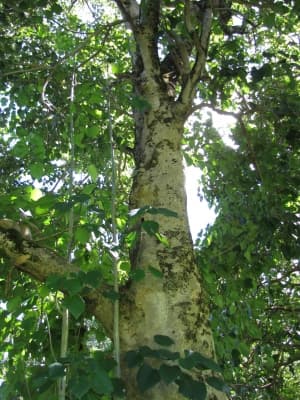
Gmelina arborea
Gmelina arborea
Safety & Hazards
None known
Cultivation Details
Gmelina arborea can succeed in very dry to wet areas in the tropics and subtropics, where it is found at elevations up to 2,100 metres. It grows best in areas where annual daytime temperatures are within the range 22 - 34°c, but can tolerate 16 - 46°c[1]. It can be killed by temperatures of 1°c or lower[1]. It prefers a mean annual rainfall in the range 1,500 - 2,500mm, but tolerates 750 - 5,000mm[1]. Requires a sunny position, even when young[2]. Grows on many soils from acidic laterites to calcareous loams, but doing poorly on thin or poor soils with hardpan, dry sands, or heavily leached acidic soils, well-drained basic alluviums[2]. It does not thrive where the drainage is poor, while on dry, sandy or otherwise poor soil it remains stunted and is apt to assume little more than a shrubby form because of repeated dying back through drought[2]. Established plants are drought tolerant[3]. Prefers a pH in the range 6 to 8[2]. Prefers a pH in the range 5 - 6, tolerating 4 - 7.5[1]. A very fast growing tree, it can reach 3 metres in height within its first year from seed and 20 metres within 4 - 5 years[1]. The first flowers are borne 3 - 4 years after planting[2]. Annual fuel wood production potential is 18 - 35 cubic metres per hectare[1]. The tree has a lifespan of about 40 years[1]. Trees coppice well with vigorous shoot growth[2]. Plants can resprout after forest fires[1]. Seed years recorded from various locations show that the tree seeds well every year. There are 2 peak periods for floral bud burst, which may vary from year to year, and with the local climatic conditions[2]. In nature, self-pollination is discouraged by the floral morphology. However, in controlled self-pollination, flowers develop into fruits[2]. Mature fruits are produced 1 week after the flowering peak and fruiting may be spread over a 2 month period[2]. Although able to compete with weeds more successfully than many other species, it responds positively to weeding and also benefits from irrigation[2]. Flowers produce abundant nectar, which produces high-quality honey[2].
Propagation
Seed - pre-treatment is not necessary, though for quick germination, the seeds should be soaked for 48 hours in warm water[2]. The seeds germinate within 20 - 50 days under ideal conditions; the average rate for a healthy seed lot is 60%[2]. Trees can be raised easily by transplanting, which is carried out in the rainy season, or by direct sowing in lines; the latter has proved to be more successful in some instances[2]. Viable seeds should be collected from standing trees of superior phenotype. Normally, seed is collected from the ground, depulped and the stones are dried. Seed storage behaviour is orthodox; viability can be maintained for several years in hermetic storage at 3°c with 7-10% mc[2]. Large cuttings planted during the rainy season do well[2]. Cite as: Tropical Plants Database, Ken Fern. tropical.theferns.info. 2026-02-20. <tropical.theferns.info/viewtropical.php?id=Gmelina+arborea>
Pollinators
Bees, Insects
References
- [1]Ecocrop — http://ecocrop.fao.org/ecocrop/srv/en/home ↩︎Basic information on a wide range of useful plants, plus details of environmental needs where available.
- [2]World Agroforesty Centre — http://www.worldagroforestry.org/ ↩︎An excellent online database of a huge range of trees giving very good information on each plant - its uses, ecology, identity, propagation, pests etc.
- [3]Tropical and Subtropical Trees - A Worldwide Encyclopaedic Guide. — Barwick. M. · Thames & Hudson, London · 2004 · ISBN 0-500-51181-0 ↩︎A superb book, very concise and well written, giving a wealth of information on 400 or more species including descriptions, habitat, cultivation details and plant uses. A wealth of colour photographs bring each plant vividly to life.
- [4]Seed Leaflets — Various · Forest & Landscape. Denmark · http://en.sl.life.ku.dk/Publikationer/Udgivelser/PopulaerPublikationer.aspx?katid={D28373CC-6EF3-4EF8-B097-6D83FABF209E}&serieid={9F1C3DB1-6E7B-4CF1-AF53-F480B0CB40EF}&sort=title ↩︎A series of leaflets, jointly produced by the University of Copenhagen and the Royal Botanic Gardens at Kew, focussing on seed information for a number species, but also giving a lot of other information about each plant.
- [5]Protabase - Plant Resources of Tropical Africa. — http://www.prota.org ↩︎An excellent on-line database with detailed information on over 3,200 species of useful plants of Africa.
- [6]Cornucopia II — Facciola. S. · Kampong Publications, California. · 1998 · ISBN 0-9628087-2-5 ↩︎The second edition of an excellent guide to the edible uses of plants, though it does not give any details of cultivation etc.
- [7]A revision of the genus Gmelina (Lamiaceae) — de Kok, Rogier · 2012 · http://www.researchgate.net/publication/236278737 · ISBN 1874-933X ↩︎A detailed revision, it also often gives plant uses. It can be downloaded from the Internet.
- [8]Tropix 7 — CIRAD · http://tropix.cirad.fr/en ↩︎An on-line guide to the timbers of 245 species of trees.