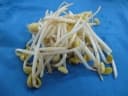
Glycine max
Glycine max
Safety & Hazards
The raw mature seed contains a range of antinutritional factors; those destroyed by heat are trypsin inhibitors, haemagglutinins, goitrogens, antivitamins, saponins and phytates; heat-stable ones are oestrogens, flatulence factors and lysinoalanine[1]. These factors can be removed in several ways - pre-soaking then cooking for several hours in water; sprouting; fermentation to make products such as miso and tempeh; and roasting can all render the seeds wholesome[2, 1].
Cultivation Details
Glycine max is a plant of the subtropics, but its cultivation extends from the tropics to as far north as latitude 52°N[3]. It does not grow well in a wet climate[4], nor will it withstand excessive heat or severe cold winters[3]. If it is to do well in temperate zones the plant requires a hot summer with a mean mid-summer temperature between 16 - 18°c[5], followed by a dry autumn[6, 7]. It grows best in areas where annual daytime temperatures are within the range 20 - 32°c, but can tolerate 10 - 38°c[8]. It prefers a mean annual rainfall in the range 600 - 1,500mm, but tolerates 450 - 1,800mm[8]. The plant has been reported to tolerate an annual precipitation up to 4,100mm[3]. A fairly easily-grown plant, it grows best in a sunny position on fertile, well-drained soils[7, 9], but does tolerate a wide range of soil conditions[3]. Soybeans develop a taproot up to 2 metres long[10] and will grow better than many crops on soils that are low in fertility, droughty or poorly drained[3]. Prefers a well-drained sandy soil[6]. Prefers a slightly acid soil[11, 5]. Prefers a pH in the range 5.5 - 6.5, tolerating 4.3 - 8.4[3, 8]. Flowering can commence from 25 - 150 days after germination, depending on daylength, temperature and cultivar[1]. Crops can be produced from 10 - 28 weeks after sowing. Average yields of 1,700kg per hectare have been obtained[3, 10]. High-yielding cultivars, adapted to the locality and grown under proper culture and favourable conditions, will yield more than twice the average yield[3]. There are many named varieties[12, 5, 3]. The species, and most of its cultivars, is a short-day plant and does not flower or set seed unless the daylight hours are less than 13 hours per day[3]. If growing the plant in the temperate zone then it is important to ensure you grow a variety suited to the longer daylight hours. There are three basic types of soya bean, those with green seeds are considered to be the most tender and best flavoured and are the type best suited for northern climates. Black seeded forms are normally used dried and yellow seeded forms are used for making soya milk, flour etc[5]. This species has a symbiotic relationship with certain soil bacteria, these bacteria form nodules on the roots and fix atmospheric nitrogen. Some of this nitrogen is utilized by the growing plant but some can also be used by other plants growing nearby[11]. Soybean soils must contain the proper nitrogen-fixing bacteria. When grown on the same land for 2 - 3 successive years, increasing yields are obtained year after year[3]. Seed can be purchased that has been treated with this rhizobium, it is unnecessary on soils with a pH below 5.5 but can be helpful on other soils[5]. When removing plant remains at the end of the growing season, it is best to only remove the aerial parts of the plant, leaving the roots in the ground to decay and release their nitrogen.
Propagation
Pre-soak the seed for 12 hours in warm water and then sow in early spring in a greenhouse. The seed should germinate within two weeks at a temperature between 12 - 16°c[5]. When they are large enough to handle, prick the seedlings out into individual pots and plant them out in late spring or early summer, after the last expected frosts. Seed can also be pre-soaked for 12 hours in warm water and then sown in situ in late spring, though this will not yield well unless the summer is very hot. Cite as: Temperate Plants Database, Ken Fern. temperate.theferns.info. 2026-02-21. <temperate.theferns.info/plant/Glycine+max>
Pollinators
Insects
References
- [1]Protabase - Plant Resources of Tropical Africa. — http://www.prota.org ↩︎An excellent on-line database with detailed information on over 3,200 species of useful plants of Africa.
- [2]Poisonous Plants in Britain and their Effects on Animals and Man. — Cooper. M. and Johnson. A. · HMSO · 1984 · ISBN 0112425291 ↩︎Concentrates mainly on the effects of poisonous plants to livestock.
- [3]Handbook of Energy Crops — Duke. J. · - · 1983 · https://hort.purdue.edu/newcrop/duke_energy/dukeindex.html · ISBN - ↩︎Published only on the Internet, excellent information on a wide range of both temperate and tropical plants.
- [4]Fruits of the Earth. — Bianchini. F., Corbetta. F. and Pistoia. M. ↩︎Lovely pictures, a very readable book.
- [5]Oriental Vegetables — Larkcom J. · John Murray · 1991 · ISBN 0-7195-4781-4 ↩︎Well written and very informative.
- [6]RHS Dictionary of Plants plus Supplement. 1956 — F. Chittendon. · Oxford University Press · 1951 · ISBN - ↩︎Comprehensive listing of species and how to grow them. Somewhat outdated, it has been replaced in 1992 by a new dictionary (see [ 200 ]).
- [7]Rare Vegetables for Garden and Table. — Organ. J. · Faber · 1960 · ISBN - ↩︎Unusual vegetables that can be grown outdoors in Britain. A good guide.
- [8]Ecocrop — http://ecocrop.fao.org/ecocrop/srv/en/home ↩︎Basic information on a wide range of useful plants, plus details of environmental needs where available.
- [9]Simmons' Manual of Fruit. — Simmons A. E. · David & Charles; Newton Abbot. · 1978 · ISBN 0-7153-7607-1 ↩︎A good guide to some of the cultivars of temperate fruits. It covers quite a wide range of fruits.
- [10]Vegetables in the Tropics — Tindall. H. D. · MacMillan, Oxford. · 1983 · ISBN 0-333-24268-8 ↩︎An excellent, in-depth look at the main vegetable crops that can be grown in the Tropics, plus many less well-known plants.
- [11]The New RHS Dictionary of Gardening. 1992. — Huxley. A. · MacMillan Press · 1992 · ISBN 0-333-47494-5 ↩︎Excellent and very comprehensive, though it contains a number of silly mistakes. Readable yet also very detailed.
- [12]Cornucopia - A Source Book of Edible Plants. — Facciola. S. · Kampong Publications · 1990 · ISBN 0-9628087-0-9 ↩︎Excellent. Contains a very wide range of conventional and unconventional food plants (including tropical) and where they can be obtained (mainly N. American nurseries but also research institutes and a lot of other nurseries from around the world.
- [13]Flora of Japan. (English translation) — Ohwi. G. · Smithsonian Institution · 1965 · ISBN - ↩︎The standard work. Brilliant, but not for the casual reader.
- [14]Sturtevant's Edible Plants of the World. — Hedrick. U. P. · Dover Publications · 1972 · ISBN 0-486-20459-6 ↩︎Lots of entries, quite a lot of information in most entries and references.
- [15]The Oxford Book of Food Plants. — Harrison. S. Wallis. M. Masefield. G. · Oxford University Press · 1975 · ISBN - ↩︎Good drawings of some of the more common food plants from around the world. Not much information though.
- [16]Dictionary of Economic Plants. — Uphof. J. C. Th. · Weinheim · 1959 · ISBN - ↩︎An excellent and very comprehensive guide but it only gives very short descriptions of the uses without any details of how to utilize the plants. Not for the casual reader.
- [17]Flowers of Europe - A Field Guide. — Polunin. O. · Oxford University Press · 1969 · ISBN 0192176218 ↩︎An excellent and well illustrated pocket guide for those with very large pockets. Also gives some details on plant uses.
- [18]Tanaka's Cyclopedia of Edible Plants of the World. — Tanaka. T. & Nakao S. · Keigaku Publishing; Tokyo · 1976 · ISBN - ↩︎The most comprehensive list of edible plants I've come across. Only the briefest entry for each species, though, and some of the entries are more than a little dubious. Not for the casual reader.
- [19]Oriental Herbs and Vegetables, Vol 39 No. 2. — Brooklyn Botanic Garden · Brooklyn Botanic Garden · 1986 · ISBN - ↩︎A small booklet packed with information.
- [20]Famine Foods listed in the Chiu-Huang Pen-ts'ao. — Reid. B. E. · Southern Materials Centre; Taipei · 1977 · ISBN - ↩︎A translation of an ancient Chinese book on edible wild foods. Fascinating.
- [21]Handbook of Chinese Herbs and Formulas. — Yeung. Him-Che. · Institute of Chinese Medicine, Los Angeles · 1985 · ISBN - ↩︎An excellent Chinese herbal giving information on over 500 species. Rather technical and probably best suited to the more accomplished user of herbs.
- [22]Medicinal Plants of China — Duke. J. A. and Ayensu. E. S. · Reference Publications, Inc. · 1985 · ISBN 0-917256-20-4 ↩︎Details of over 1,200 medicinal plants of China and brief details of their uses. Often includes an analysis, or at least a list of constituents. Heavy going if you are not into the subject.
- [23]Estrogen-like activities and cytotoxicity effects of Thai herbal medicines as natural ingredients in anti-ageing — Bancha Yingngam, Nuttapun Supaka & Wandee Rungseevijitprapa · 2011 · http://10.5897/JMPR11.1223 · ISBN 1996-0875 ↩︎
- [24]Medicinal Plants in the Republic of Korea — World Health Organisation, Manila · 1998 · ISBN 92 9061 120 0 ↩︎An excellent book with terse details about the medicinal uses of the plants with references to scientific trials. All plants are described, illustrated and brief details of habitats given.
- [25]Glossary of Indian Medicinal Plants (Including the Supplement). — Chopra. R. N., Nayar. S. L. and Chopra. I. C. · Council of Scientific and Industrial Research, New Delhi. · 1986 · ISBN - ↩︎Very terse details of medicinal uses of plants with a wide range of references and details of research into the plants chemistry. Not for the casual reader.
- [26]Economic Botany. — Hill. A. F. · The Maple Press · 1952 · ISBN - ↩︎Not very comprehensive, but it is quite readable and goes into some detail about the plants it does cover.
- [27]Plants for Man. — Schery. R. W. ↩︎Fairly readable but not very comprehensive. Deals with plants from around the world.