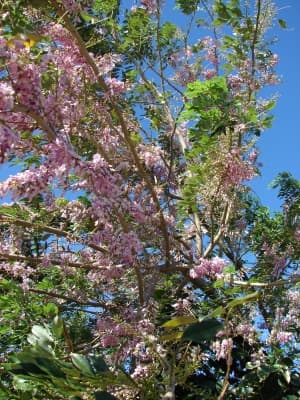
Gliricidia sepium
Gliricidia sepium
Safety & Hazards
The leaves, seeds or powdered bark are toxic to human, When mixed with cooked rice or maize and then fermented, they are used to poison rats, mice and other rodents[1]. Leaves are reputedly toxic to dogs and horses, but cows and goats are said to ingest them with impunity[2]. The mechanism of toxicity is not understood[3].
Cultivation Details
Gliricidia sepium is a plant of the moist tropics, where it is found at elevations up to 1,600 metres. It grows best in areas where annual daytime temperatures are within the range 15 - 30°c, but can tolerate 12 - 44°c[4]. Mature plants can be killed by temperatures of -2°c or lower, but young growth is more sensitive and will be severely damaged at -1°c[4]. The plant prefers a mean annual rainfall in the range 1,200 - 2,300mm, but tolerates 600 - 3,500mm[4]. In its native range the climate is relatively uniformly sub-humid with a five-month dry period, though it can also grow successfully in more humid zones without a marked dry season (though it does not set seed then)[3, 5]. Grows best in a sunny position[6]. Tolerates a wide range of soil types, both alkaline and acidic, including low-fertility soils[3]. It grows well on the calcareous soils of atolls[7]. Prefers freely draining soils but can tolerate some waterlogging[3]. Prefers a pH in the range 5.5 - 6.2, tolerating 4.5 - 8[4]. Plants establish well on steep slopes with up to 40% gradient[3]. As an aggressive coloniser, the plant has the potential to become a weed but is rarely so perhaps because it in most places is coppiced regularly and not permitted to set seed[5]. A fast growing tree, capable of increases in height of 3 metres or more per year, though early seedling growth is quite slow[4]. When grown as a fuel crop, the first harvest can be taken after 3 - 4 years, giving wood yields of 8 - 15 cubic metres per hectare. Subsequent coppicing is done every 2 - 3 years and yields may be 11 - 21 cubic metres[4]. Gliricidia is often exposed to annual fires in its native, seasonally dry habitat[3]. It tolerates such fires well and trees quickly resprout when the rains start, which explains the abundance of the tree in secondary vegetations and fallows[3]. There is a predictable relationship between the flowering of the plant and the onset of the rainy season in Venezuela, making it a promising indicator species[3]. In many parts of the naturalized range and where it is an exotic, flowering can occur any time of the year if there is no pronounced dry season[3]. Pod-ripening time ranges between 35 and 60 days. Pods can grow to full size within 3 weeks of fertilization. On maturity, pods dehisce explosively; tension builds up in the pod valves and the seeds are ejected to a distance of 25 metres. This phenomenon facilitates rapid establishment, especially in disturbed sites, and also means that in some areas the plant has become invasive[8]. Wind plays a part in the direction of seed dispersal. Secondary dispersal by rain is also possible[3]. Pollarding at 2 metres or above is recommended for optimal wood biomass production[3]. Coppicing is used where the primary objective is fuel wood production[3]. The plant has been shown to tolerate lopping and browsing[3]. This species has a symbiotic relationship with certain soil bacteria, these bacteria form nodules on the roots and fix atmospheric nitrogen. Some of this nitrogen is utilized by the growing plant but some can also be used by other plants growing nearby[6].
Propagation
Seed - pre-treatment is often not necessary, particularly where fresh seeds are used. However, when seeds are not fresh, soaking overnight in hot water is required and planting should proceed immediately thereafter[3]. Seed or seedling inoculation with suitable strains of rhizobium is necessary where the plant is not naturalized. Direct sowing of seeds requires good land preparation and regular weeding[3]: 90 - 100% germination occurs in 7 days[3]. Where nursery seedlings are used, plantable size is attained in 3 months[3]. Seed storage behaviour is orthodox. Viability is maintained for 12 months in open storage. Glricidia is propagated most commonly by cuttings, although this is not the most appropriate method for establishment in poor soils[3]. Even very large cuttings root successfully in the open ground[8]. Cite as: Tropical Plants Database, Ken Fern. tropical.theferns.info. 2026-02-20. <tropical.theferns.info/viewtropical.php?id=Gliricidia+sepium>
Pollinators
Bees, Insects
References
- [1]Common Trees of Puerto Rico and the Virgin Islands — Little E.L.; Wadsworth F.H. · USDA, Forest Service; Washington. · 1964 ↩︎Contains detailed information, and usually an illustration, on 250 tree species, including both native and exotic species.
- [2]The Leguminosae; A Source Book of Characteristics, Uses and Nodulation — Allen O.N.; Allen E.K. · University of Wisconsin · 1981 · ISBN 0-333-32221-5 ↩︎An amazing and comprehensive work, giving a brief guide to the many genera of the family Fabaceae and also the principle uses of the genus.
- [3]World Agroforesty Centre — http://www.worldagroforestry.org/ ↩︎An excellent online database of a huge range of trees giving very good information on each plant - its uses, ecology, identity, propagation, pests etc.
- [4]Ecocrop — http://ecocrop.fao.org/ecocrop/srv/en/home ↩︎Basic information on a wide range of useful plants, plus details of environmental needs where available.
- [5]Seed Leaflets — Various · Forest & Landscape. Denmark · http://en.sl.life.ku.dk/Publikationer/Udgivelser/PopulaerPublikationer.aspx?katid={D28373CC-6EF3-4EF8-B097-6D83FABF209E}&serieid={9F1C3DB1-6E7B-4CF1-AF53-F480B0CB40EF}&sort=title ↩︎A series of leaflets, jointly produced by the University of Copenhagen and the Royal Botanic Gardens at Kew, focussing on seed information for a number species, but also giving a lot of other information about each plant.
- [6]The New RHS Dictionary of Gardening. 1992. — Huxley. A. · MacMillan Press · 1992 · ISBN 0-333-47494-5 ↩︎Excellent and very comprehensive, though it contains a number of silly mistakes. Readable yet also very detailed.
- [7]Agroforestry in the Pacific Islands: Systems for Sustainability — W.C. Clarke and R.R. Thaman (Editors) · United Nations University Press, Tokyo · 1993 · http://www.unu.edu/unupress/unupbooks/80824e/80824E00.htm#Contents · ISBN 92-808-0824-9 ↩︎The guide includes information on 100 species of plants for Agroforestry. It is also available on the web at the address given above.
- [8]Tropical and Subtropical Trees - A Worldwide Encyclopaedic Guide. — Barwick. M. · Thames & Hudson, London · 2004 · ISBN 0-500-51181-0 ↩︎A superb book, very concise and well written, giving a wealth of information on 400 or more species including descriptions, habitat, cultivation details and plant uses. A wealth of colour photographs bring each plant vividly to life.
- [9]Mansfeld's Database of Agricultural and Horticultural Plants — http://mansfeld.ipk-gatersleben.de/pls/htmldb_pgrc/f?p=185:3:4292127278597336 ↩︎Terse details of a huge range of useful plants.
- [10]Cornucopia II — Facciola. S. · Kampong Publications, California. · 1998 · ISBN 0-9628087-2-5 ↩︎The second edition of an excellent guide to the edible uses of plants, though it does not give any details of cultivation etc.
- [11]A Century of Trees of Panama. — Pittier H. Mell C.D. · http://www.biodiversitylibrary.org ↩︎A work that was very difficult to get published according to the correspondence contained at the start!. A treatment of 100 different species with descriptions and details of uses. It can be downloaded from the Internet.
- [12]CosIng — http://ec.europa.eu/growth/tools-databases/cosing/ ↩︎CosIng is the European Commission database for information on cosmetic substances and ingredients.