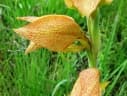
Gladiolus dalenii
Gladiolus dalenii
Safety & Hazards
None known
Cultivation Details
Gladiolus dalenii is native mainly to the seasonally dry tropical regions of Africa. It is found in areas with summer rainfall[1]. Prefers a sunny sheltered position in a well-drained, light, sandy, neutral to slightly acid soil[2, 1, 3]. Requires a stony gritty loam. A parent of some garden hybrids[2]. The plant is said to inhibit the growth of legumes[4].
Propagation
Seed - sow early spring in a greenhouse at 15°c[1]. It usually germinates freely[2]. The seed can also be sown as soon as it is ripe in the autumn in a warm greenhouse[1]. Sow the seed thinly so that the seedlings can be grown on in the pot without disturbance for their first year, giving them an occasional liquid feed to ensure they do not become nutrient deficient. Pot up the small bulbs when they are dormant in the autumn, placing about 2 - 3 bulbs in each pot. Grow them on for another year or two in the greenhouse and then plant them out in late spring. Division. Dig up the corms in early autumn, dry them in well ventilated conditions at about 20°c and then store them in a cool but frost-free place over the winter, planting them out about 10cm deep in mid spring[2, 1]. Cormlets harvested when digging up the corms in the autumn can be stored in a similar manner to the corms[1]. Larger cormlets can be planted out in spring, smaller ones may be best grown on for a year in the greenhouse. Cite as: Temperate Plants Database, Ken Fern. temperate.theferns.info. 2026-02-21. <temperate.theferns.info/plant/Gladiolus+dalenii>
Pollinators
Insects
References
- [1]The New RHS Dictionary of Gardening. 1992. — Huxley. A. · MacMillan Press · 1992 · ISBN 0-333-47494-5 ↩︎Excellent and very comprehensive, though it contains a number of silly mistakes. Readable yet also very detailed.
- [2]RHS Dictionary of Plants plus Supplement. 1956 — F. Chittendon. · Oxford University Press · 1951 · ISBN - ↩︎Comprehensive listing of species and how to grow them. Somewhat outdated, it has been replaced in 1992 by a new dictionary (see [ 200 ]).
- [3]Bihrmann's Caudiciforms — http://www.bihrmann.com/caudiciforms/ ↩︎An internet site giving information on caudiciform plants (plants with swollen stem bases such as the Baobab tree, cycads and many succulents). Excellent photos, usually of cultivated plants in pots.
- [4]How to Enjoy your Weeds. — Hatfield. A. W. · Frederick Muller Ltd · 1977 · ISBN 0-584-10141-4 ↩︎Interesting reading.
- [5]Flora Zambesiaca — http://apps.kew.org/efloras/fz/intro.html ↩︎An excellent online flora of plants from the Zambezi River basin. It lists a number of the plant uses as well as the habitats and botanical descriptions of the plants.
- [6]Useful Plants of Kongo Central Province, Democratic Republic of Congo (Third Edition) — Paul Latham & Augustin Konda ku Mbuta · 2017 · ISBN 978-0-9554208-70 ↩︎An excellent publication, clear and precise by people who know their subject. Originally published in French, then translated into English and also made available in two parts in PDF format as a download from the internet.
- [7]Dictionary of Economic Plants. — Uphof. J. C. Th. · Weinheim · 1959 · ISBN - ↩︎An excellent and very comprehensive guide but it only gives very short descriptions of the uses without any details of how to utilize the plants. Not for the casual reader.
- [8]Conservatory and Indoor Plants Volumes 1 & 2 — Phillips. R. & Rix. M. · Pan Books, London. · 1998 · ISBN 0-330-37376-5 ↩︎Excellent photos of over 1,100 species and cultivars with habits and cultivation details plus a few plant uses. Many species are too tender for outdoors in Britain though there are many that can be grown outside.
- [9]Flore de Madagascar et des Comores — Humbert H. · Museum National D'Histoire Naturelle; Paris · 1946 - 1984 · http://www.biodiversitylibrary.org/ ↩︎Written in French, an excellent flora of the area though it has not been completed. Available for download from the Internet.
- [10]Plants of the northern provinces of South Africa: keys and diagnostic characters — Retief E. & Herman P.P.J. · National Botanical Institute, Pretoria. · 1997 · ISBN 1-874907-30-7 ↩︎
- [11]A Dictionary of Plants Used by Man. — Usher. G. · Constable · 1974 · ISBN 0094579202 ↩︎Forget the sexist title, this is one of the best books on the subject. Lists a very extensive range of useful plants from around the world with very brief details of the uses. Not for the casual reader.
- [12]Tanaka's Cyclopedia of Edible Plants of the World. — Tanaka. T. & Nakao S. · Keigaku Publishing; Tokyo · 1976 · ISBN - ↩︎The most comprehensive list of edible plants I've come across. Only the briefest entry for each species, though, and some of the entries are more than a little dubious. Not for the casual reader.
- [13]Cornucopia II — Facciola. S. · Kampong Publications, California. · 1998 · ISBN 0-9628087-2-5 ↩︎The second edition of an excellent guide to the edible uses of plants, though it does not give any details of cultivation etc.
- [14]Ethnobotanicals of the Western Ghats — Noorunnisa Begum S., Ravikumar K. & Ved D.K. · Apple Academic Press; Oakville, Canada · 2017 · ISBN 978-1-77188-404-4 ↩︎