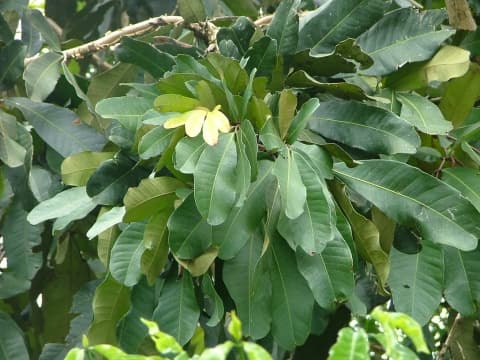
Gilbertiodendron dewevrei
Gilbertiodendron dewevrei
Safety & Hazards
None known
Cultivation Details
Gilbertiodendron dewevrei occurs below 1,000 metres elevation, in areas with an average annual rainfall of 1,600 - 1,900mm and a dry season of about 2 months[1]. When growing on deep, well-draining sandy soils, the tree forms a deep tap root; but on stony soils tap root formation is difficult, and the formation of lateral roots becomes prominent[1]. Flowering does not always occur annually, and many flowers are shed without forming fruits. Still, fruiting is usually abundant, with mast seed production every 2 - 4 years[1]. Seed dispersal is ballistic, with the seeds being ejected after explosive dehiscence of the fruit[1]. Natural regeneration is abundant under shade, and seedlings tolerate dense shade for a long time[1]. The average annual increase in stem diameter is 5.3 mm. Observations on 10 trees originating from Gabon and Congo show annual increases in stem diameter of 2.6 - 11.4 mm[1]. The tree can form extensive, almost pure stands, sometimes covering more than 10,000 ha. In these monodominant forests, Gilbertiodendron dewevrei forms 75 - 88% of the basal area. In DR Congo these stands typically consist of 3 layers: a continuous upper tree layer about 35 metres high, almost uniformly consisting of Gilbertiodendron dewevrei, with in some places the crown of another large, sun-loving tree species; a not very dense middle layer mainly consisting of young Gilbertiodendron dewevrei mixed with several rare semi-heliophytes; a shrub layer; and a discontinuous herbaceous layer of Marantaceae and Commelinaceae. The monodominant Gilbertiodendron dewevrei forests are very sensitive to forest clearing for shifting cultivation, because this permits the penetration of secondary and deciduous species into the forest. If forest clearing is too substantial and frequent, the monodominant forests may be transformed into semi-deciduous forest or degraded savannah after only 4 - 6 years of cultivation. Near the northern and southern limits of its distribution area, Gilbertiodendron dewevrei does not form stands as extensive as in the northern Congo basin, but it persists along rivers. Where Gilbertiodendron dewevrei is found in heterogeneous forest, it is never as isolated trees, but always in groups[1]. In natural forest, suppression of the herbaceous layer makes the establishment of Gilbertiodendron dewevrei seedlings even more abundant. Although the species is typically shade-loving, moderate light is beneficial for the growth of seedlings, but full light has adverse effect. Excessive opening of the canopy of dense Gilbertiodendron dewevrei stands will favour the establishment of light-loving species with rapid growth, often accompanied by abundant growth of lianas, which is not desirable for the establishment of exploitable Gilbertiodendron dewevrei stands[1]. The roots are colonized by ectomycorrhizae and vesicular-arbuscular endomycorrhizae. The proportion of the roots that is colonized by ectomycorrhizae increases with age in saplings. The rapid colonization of the roots by ectomycorrhizae gives the seedlings an advantage over species that are not or more slowly colonized. In dense, undisturbed stands, the roots are not nodulating with Rhizobium, but some root nodules can be found in disturbed forest[1]. There are conflicting reports on whether or not this species has a symbiotic relationship with certain soil bacteria, so it is unclear as to whether it fixes atmospheric nitrogen[2].
Propagation
Seed - best sown as soon as it is ripe. Germination is rapid, usually within 5 - 7 days after seed dispersal. Seedlings can be planted out after 9 - 12 months in the nursery[1]. Cite as: Tropical Plants Database, Ken Fern. tropical.theferns.info. 2026-02-20. <tropical.theferns.info/viewtropical.php?id=Gilbertiodendron+dewevrei>
Pollinators
Data unavailable
References
- [1]Protabase - Plant Resources of Tropical Africa. — http://www.prota.org ↩︎An excellent on-line database with detailed information on over 3,200 species of useful plants of Africa.
- [2]Nodulation Plants in GRIN Taxonomy — United States Department of Agriculture · http://www.ars-grin.gov/~sbmljw/cgi-bin/taxnodul.pl?language=en ↩︎An online database listing plants that have either positive or negative reports on root and stem nodulation with nitrogen-fixing bacteria.
- [3]African Flowering Plants Database — Conservatoire et Jardin Botaniques. · http://www.ville-ge.ch/musinfo/bd/cjb/africa/recherche.php ↩︎Contains information on over 150,000 plant names (including synonyms) giving a description and habitat, plus a distribution map.