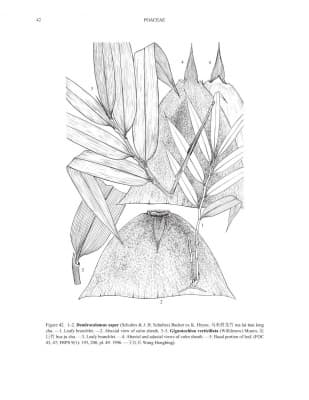
Gigantochloa verticillata
Gigantochloa verticillata
Safety & Hazards
None known
Cultivation Details
A plant of the perhumid tropics growing at elevations from sea-level up to about 1,200 metres[1]. It is found in areas with an annual rainfall in the range of 2,350 - 4,200 mm, an average temperature of 20 - 32°c and average relative humidity of over 70%[1]. In Indonesia (West Java), the culms grown on hill slopes ( at elevations of 500 metres with an annual rainfall of around 4,200 mm) are stronger (higher specific gravity, bending and tensile strength) than culms grown in valleys[1]. Grows best on sandy loams and alluvial soils[1]. One year after planting of a cutting, 7 - 10 culms have emerged[1]. Per year, about 8 - 9 culms per clump reach full size[1]. Bamboos have an interesting method of growth. Each plant produces a number of new stems annually - these stems grow to their maximum height in their first year of growth, subsequent growth in the stem being limited to the production of new side branches and leaves. In the case of some mature tropical species the new stem could be as much as 30 metres tall, with daily increases in height of 30cm or more during their peak growth time. This makes them some of the fastest-growing species in the world[PFAF]. A young culm grows fast, attaining full height in 3 - 4 months with an average growing rate of 3.4 cm per day[1]. Bamboos in general are usually monocarpic, living for many years before flowering, then flowering and seeding profusely for a period of 1 - 3 years before usually dying. Flowering occurs when the clump is 50 - 60 years old; it flowers gregariously, after which the clump dies[1]. First harvesting may start 3 years after planting, preferably in the dry season[1]. It is recommended to harvest only 3-year-old culms and to cut just above the ground[1]. To promote regeneration, it is recommended to earth up and to mulch the base of the harvested culms[1]. The annual yield of mature culms from a plantation with 275 clumps per ha (6 m x 6 m) is estimated at 1,650 per ha or about 6 culms per clump[310. If converted to charcoal, about 18% good charcoal and 4% brand and broken charcoal are produced310]. Traditionally, the culms are left leaning upright against a tree for some days before being used. Sometimes culms are first soaked in running water or mud for some time[1]. Experiments with preservation by soaking in a chemical solution of e.g. Caustic soda or boric acid show promising results[1].
Propagation
Gigantochloa pseudoarundinacea is only propagated vegetatively by rhizome, culm or branch cuttings. Cuttings from flowering clumps should be avoided because they will start flowering soon after planting. Culm cuttings have shown a survival rate of nearly 100%. In Indonesia, the best time for planting is in the rainy season from December to March. Recommended spacing is 8 m x 8 m, and high rainfall areas are preferred[1]. Cite as: Tropical Plants Database, Ken Fern. tropical.theferns.info. 2026-02-20. <tropical.theferns.info/viewtropical.php?id=Gigantochloa+verticillata>
Pollinators
Data unavailable
References
- [1]Plant Resources of Southeast Asia — http://proseanet.org/ ↩︎Lots of information on the uses of the plants of SE Asia.
- [2]Bamboos of India: A Compendium — Seethalakshmi K.K., Muktesh Kumar M.S. · Brill. · 2002 · http://www.inbar.int/publication/txt/tr17/default.htm · ISBN 8186247254 ↩︎A very good book giving botanical descriptions of the plants with brief notes on subjects such as uses, habitat and range. It is also available to view on the Internet.
- [3]Annals of the Royal Botanic Garden, Calcutta. Vol. 7 — Gamble J.S. · Bengal Secretariat Press; Calcutta. · 1896 · http://www.biodiversitylibrary.org ↩︎A very comprehensive listing of the bamboos of India, as they were known at the end of the 19th Century. Includes some information on plant uses. It can be downloaded from the Internet.
- [4]Mansfeld's Database of Agricultural and Horticultural Plants — http://mansfeld.ipk-gatersleben.de/pls/htmldb_pgrc/f?p=185:3:4292127278597336 ↩︎Terse details of a huge range of useful plants.
- [5]Flora of China — Missouri Botanical Garden Press; St. Louis. · 1994 · http://flora.huh.harvard.edu/china/ ↩︎An excellent, comprehensive resource in 25 volumes. In addition to the botanical information the flora also gives basic information on habitat and some uses. An on-line version is also available.
- [PFAF]Plants for a Future — pfaf.org ↩︎