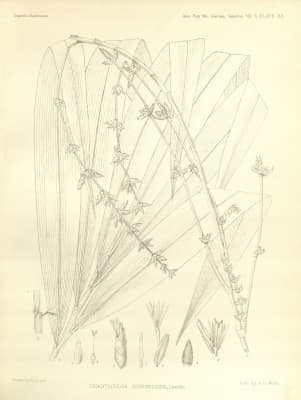
Gigantochloa scortechinii
Gigantochloa scortechinii
Safety & Hazards
None known
Cultivation Details
A plant of the moist tropics, where it can be found at elevations up to 1,000 metres. The plant grows wild in areas where the mean annual maximum temperature is about 32°c; the mean minimum temperature 22°c; and mean annual rainfall is about 2,500mm, quite evenly distributed over the year[1]. The plant will grow in any soil type, but does best on sandy loams with good drainage and a pH in the range 5.0 - 6.5. It thrives well in ravines, gulleys and logged-over areas and is quite aggressive once it is exposed to sunlight[1]. Only mature culms of 3 years or older should be harvested, taking care not to harvest from the periphery of a clump and to leave the culms evenly spaced in the clump.Culms can be harvested all the year round. Felling intensities up to 70% of the total number of culms of a clump are possible without visible negative effect on regrowth[1]. A properly managed plantation may produce 3,600 - 4,000 culms per hectare, or 40 - 50 tonnes green weight per year[1]. Bamboos have an interesting method of growth. Each plant produces a number of new stems annually - these stems grow to their maximum height in their first year of growth, subsequent growth in the stem being limited to the production of new side branches and leaves. In the case of some mature tropical species the new stem could be as much as 30 metres tall, with daily increases in height of 30cm or more during their peak growth time. This makes them some of the fastest-growing species in the world[PFAF]. Bamboos in general are usually monocarpic, living for many years before flowering, then flowering and seeding profusely for a period of 1 - 3 years before usually dying. Bamboos in general are usually monocarpic, living for many years before flowering, then flowering and seeding profusely for a period of 1 - 3 years before usually dying. This pattern can vary - sometimes flowering is sporadic, with plants flowering annually and not dying; at other times it is gregarious with all the plants in a specific species coming into flower at the same time. Flowering of this species is sporadic, with only a portion of one clump flowering at a time; gregarious flowering has never been reported[1, 2]. Under natural conditions, shoots of this species emerge above the ground during the rainy season and develop to their full height in 4 months. A strong, positive correlation exists between the amount of previous year rainfall and the number of emerging shoots. A culm becomes mature in 3 years. A good, healthy clump can produce 48 - 60 shoots annually, but only about 40% of these reach maturity[1]. One-year-old seedlings attain about 1.10 m in length; in the next year they develop 2 - 4 new culms, after which clump formation develops rapidly[1]. Plants raised from culm cuttings initially produce small shoots (3 the first year) which develop into small culms. In the following year shoots develop into larger culms, and after 6 - 7 years the shoots develop into full-sized culms[1].
Propagation
Seed - sow in containers or a nursery seedbed in a lightly shaded position, Only just cover the seed and do not allow to dry out. A germination rate of around 70 - 75% can be expected[1]. Rhizome cuttings (rhizome part, with roots and 60 - 100cm basal part of a one-year-old culm) are planted out directly and are successful, but this method is not suitable for large-scale propagation[1]. Culm cuttings are raised in a nursery for 4 - 6 months and transplanted when they have produced roots, preferably at the onset of the rainy season[1]. Cite as: Tropical Plants Database, Ken Fern. tropical.theferns.info. 2026-02-20. <tropical.theferns.info/viewtropical.php?id=Gigantochloa+scortechinii>
Pollinators
Wind
References
- [1]Plant Resources of Southeast Asia — http://proseanet.org/ ↩︎Lots of information on the uses of the plants of SE Asia.
- [2]The Gardens' Bulletin Vol. 16 — The Botanic Gardens; Singapore · 1958 · http://www.biodiversitylibrary.org/Default.aspx ↩︎A botanical journal - this issue includes a treatment of the Bamboos in Malaya and the Myristicaceae in Malaya. It can be downloaded from the Internet.
- [PFAF]Plants for a Future — pfaf.org ↩︎