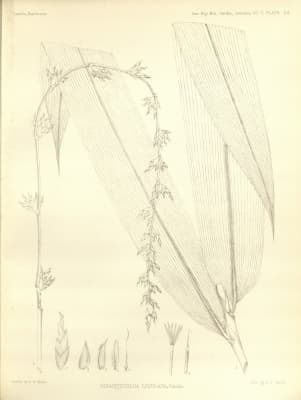
Gigantochloa ligulata
Gigantochloa ligulata
Safety & Hazards
None known
Cultivation Details
The plant is found mainly on sandy soils in the wild[1]. A mature clump usually contains 30 - 40 culms (though this can range from 15 - 70), and usually produces 13 - 15 young shoots per year[1]. Bamboos have an interesting method of growth. Each plant produces a number of new stems annually - these stems grow to their maximum height in their first year of growth, subsequent growth in the stem being limited to the production of new side branches and leaves. In the case of some mature tropical species the new stem could be as much as 30 metres tall, with daily increases in height of 30cm or more during their peak growth time. This makes them some of the fastest-growing species in the world[PFAF]. Bamboos in general are usually monocarpic, living for many years before flowering, then flowering and seeding profusely for a period of 1 - 3 years before usually dying. Bamboos in general are usually monocarpic, living for many years before flowering, then flowering and seeding profusely for a period of 1 - 3 years before usually dying. This pattern can vary - sometimes flowering is sporadic, with plants flowering annually and not dying; at other times it is gregarious with all the plants in a specific species coming into flower at the same time. Sporadic flowering in this species is quite often seen, but gregarious flowering of whole clumps has rarely been reported and gGregarious flowering of many clumps over large areas has never been observed[1]. The flowering cycle is still not properly known, but in a case of gregarious flowering in Kedah the flowering period lasted 6 months, after which the clump died[1]. This is a very variable species that still needs further investigation. Roughly, two groups of specimens can be distinguished (unnamed): one with medium-sized, thick-walled culms with 2 perfect florets in the pseudospikelets and another with larger culms, larger culm-sheath ligules and 3 - 4 perfect florets in the pseudospikelets (the vernacular names for the latter group in Peninsular Malaysia are: buloh bilalai, buloh gala, buloh mata rusa)[1].
Propagation
Seed - About 8 weeks after sowing, the first culm of a seedling is 13cm tall with 5 - 6 expanded leaves[1]. Cite as: Tropical Plants Database, Ken Fern. tropical.theferns.info. 2026-02-20. <tropical.theferns.info/viewtropical.php?id=Gigantochloa+ligulata>
Pollinators
Wind
References
- [1]Plant Resources of Southeast Asia — http://proseanet.org/ ↩︎Lots of information on the uses of the plants of SE Asia.
- [2]The Gardens' Bulletin Vol. 16 — The Botanic Gardens; Singapore · 1958 · http://www.biodiversitylibrary.org/Default.aspx ↩︎A botanical journal - this issue includes a treatment of the Bamboos in Malaya and the Myristicaceae in Malaya. It can be downloaded from the Internet.
- [PFAF]Plants for a Future — pfaf.org ↩︎