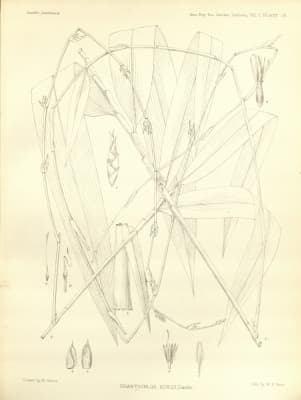
Gigantochloa apus
Gigantochloa apus
Safety & Hazards
None known
Cultivation Details
Prefers growing in the tropical humid low-lands, but also occurs on hill slopes at elevations up to 1,500 metres[1]. Grows well in clay soils[1]. When growing in drier areas, the culms remain smaller[1]. One year after planting the vegetatively obtained propagules, about 10 - 15 culms will emerge; they are harvestable 1 - 3 years later, depending on the use[2]. Annual yields of 1,000 culms per hectare can be obtained[2]. Bamboos have an interesting method of growth. Each plant produces a number of new stems annually - these stems grow to their maximum height in their first year of growth, subsequent growth in the stem being limited to the production of new side branches and leaves. In the case of some mature tropical species the new stem could be as much as 30 metres tall, with daily increases in height of 30cm or more during their peak growth time. This makes them some of the fastest-growing species in the world[PFAF]. Bamboos in general are usually monocarpic, living for many years before flowering, then flowering and seeding profusely for a period of 1 - 3 years before usually dying. The plant flowers very rarely - in Indonesia, flowering may start 50 - 60 years after planting[2]. When flowering, viable seed is produced that can be used for propagation[2]. The overlapping of rhizomes in old clumps often raises the middle portion of the clump high above the ground[1]. The culm size can vary considerably, leading local people to use different names for plants with different culm sizes[1].
Propagation
Seed - Rhizome cuttings consist of fragments of young rhizomes bearing 1 - 2 culm buds[1]. They are raised in a nursery and, when well rooted, are transplanted to the field at a spacing of 5 - 7 m2[1]. Culm cuttings consist of culm segments or whole culms. Good results were obtained with one-year-old culm segments bearing 2 buds each[1]. The cuttings are set upright or at an angle, with the node well covered with soil[1]. It is not advisable to propagate vegetatively from flowering clumps, as the new plants will also start flowering soon after planting[1]. Cite as: Tropical Plants Database, Ken Fern. tropical.theferns.info. 2026-02-20. <tropical.theferns.info/viewtropical.php?id=Gigantochloa+apus>
Pollinators
Wind
References
- [1]World Agroforesty Centre — http://www.worldagroforestry.org/ ↩︎An excellent online database of a huge range of trees giving very good information on each plant - its uses, ecology, identity, propagation, pests etc.
- [2]Plant Resources of Southeast Asia — http://proseanet.org/ ↩︎Lots of information on the uses of the plants of SE Asia.
- [3]The Gardens' Bulletin Vol. 16 — The Botanic Gardens; Singapore · 1958 · http://www.biodiversitylibrary.org/Default.aspx ↩︎A botanical journal - this issue includes a treatment of the Bamboos in Malaya and the Myristicaceae in Malaya. It can be downloaded from the Internet.
- [PFAF]Plants for a Future — pfaf.org ↩︎