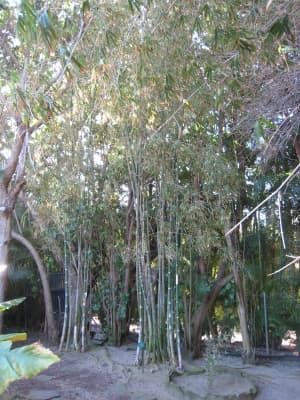
Gigantochloa albociliata
Gigantochloa albociliata
Safety & Hazards
None known
Cultivation Details
Gigantochloa albociliata grows naturally in the dry tropical mixed forest at low to medium elevations. It is found in areas where the mean annual rainfall is in the range of 800 - 1,300mm, and the mean annual temperature is around 28°c[1].. Succeeds in well-drained soils of poor to medium fertility[1]. Annual culm production in natural stands is 9 - 46 tonnes per hectare[1]. A 6 year old clump raised from a rhizome cutting produced 27 culms with an average height of 10.5 metres (ranging from 5 - 16 metres), with an average diameter of 20mm (ranging from 10 - 30mm). A mature clump in a natural stand in Thailand can bear 50 - 60 culms[1]. Bamboos have an interesting method of growth. Each plant produces a number of new stems annually - these stems grow to their maximum height in their first year of growth, subsequent growth in the stem being limited to the production of new side branches and leaves. In the case of some mature tropical species the new stem could be as much as 30 metres tall, with daily increases in height of 30cm or more during their peak growth time. This makes them some of the fastest-growing species in the world[PFAF]. Bamboos in general are usually monocarpic, living for many years before flowering, then flowering and seeding profusely for a period of 1 - 3 years before usually dying. This pattern can vary - sometimes flowering is sporadic, with plants flowering annually and not dying; at other times it is gregarious with all the plants in a specific species coming into flower at the same time. This species flowers both sporadically and gregariously. In Thailand, sporadic flowering is common whilst a flowering cycle of 30 years has been reported from Assam [1, 2]. Seeds from sporadic flowering are often not fertile[2]. Normally, 3-year-old culms are harvested in a 3-year felling cycle, usually at the end of the dry season. Culms used for furniture need to be flexible and so are harvested when 2 years old, and cut close to the ground (the basal 1 - 2 metres is the most useful section because of the thicker wall), because 3-year-old culms are too stiff to bend and younger culms normally shrink during firing. Culms harvested at the end of the dry season are more resistant to borer attack[1]. Young shoots for food are harvested in the rainy season[1]. Traditional and chemical treatments are employed to preserve culms. Traditionally, culms are submerged in running water for 10 - 20 days. The culms are cleaned by rubbing with coconut husks or rice straw dipped in wet wood ash for a shiny surface, otherwise sandpaper is used. Chemical treatments include boiling the culms for 15 - 20 minutes at 95°c in a solution of 0.2% sodium carbonate or 0.1% calcium hydroxide, or at 80°c in a 0.3% copper sulphate solution. After the treatments, culms are washed with water, dried in the sun for 1 - 2 days, and stored in well ventilated rooms[1].
Propagation
Seed - Rhizome cuttings are planted, using portions of the culm 30 - 50cm long. For small-scale planting seedlings are also collected from the forest. Cite as: Tropical Plants Database, Ken Fern. tropical.theferns.info. 2026-02-20. <tropical.theferns.info/viewtropical.php?id=Gigantochloa+albociliata>
Pollinators
Wind
References
- [1]Plant Resources of Southeast Asia — http://proseanet.org/ ↩︎Lots of information on the uses of the plants of SE Asia.
- [2]Bamboos of India: A Compendium — Seethalakshmi K.K., Muktesh Kumar M.S. · Brill. · 2002 · http://www.inbar.int/publication/txt/tr17/default.htm · ISBN 8186247254 ↩︎A very good book giving botanical descriptions of the plants with brief notes on subjects such as uses, habitat and range. It is also available to view on the Internet.
- [PFAF]Plants for a Future — pfaf.org ↩︎