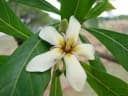
Genipa americana
Genipa americana
Safety & Hazards
None known
Cultivation Details
A plant of the moist, lowland tropics, where it is found at elevations up to 400 metres[1]. It grows best in areas where annual daytime temperatures are within the range 24 - 31°c, but can tolerate 12 - 35°c[1]. Mature plants can be killed by temperatures of -3°c or lower, but young growth will be severely damaged at -1°c[1]. It prefers a mean annual rainfall in the range 1,200 - 1,700mm, but tolerates 900 - 2,000mm[1]. It tolerates an annual rainfall of 1,200 - 4,000 mm[2]. It tolerates dry periods of up to 6 months, but will then shed its leaves for a time[3, 2]. An easily grown plant, it prefers a rich, humid, well-drained soil in full sun to partial shade[3]. Prefers a pH in the range 5.5 - 7, tolerating 5 - 8[1]. The plant tolerates periods of flooding in its native range[4]. Plants can begin to flower when 3 - 5 years old from seed[1].
Propagation
Seed - it is not dormant and so pre-treatment is not necessary. However, soaking the seeds in running water for 1 - 2 days just prior to sowing will accelerate germination[2]. Seed may be sown in light shade in a nursery seedbed. Germination rates are normally high with between 65 - 100% of the seed sprouting within 1 - 4 weeks. The seedlings are ready for pricking out about 20 days later[2]. Initial growth rates are slow, taking about 12 months to attain a transplanting size of 20 - 40cm[2]. Because of drought sensitivity the best way of establishment is to use containerised seedlings[2]. Vegetative propagation by cuttings is also possible[2]. Grafting is used for varieties with superior fruit quality[2]. Cite as: Tropical Plants Database, Ken Fern. tropical.theferns.info. 2026-02-20. <tropical.theferns.info/viewtropical.php?id=Genipa+americana>
Pollinators
Bees
References
- [1]Ecocrop — http://ecocrop.fao.org/ecocrop/srv/en/home ↩︎Basic information on a wide range of useful plants, plus details of environmental needs where available.
- [2]Seed Leaflets — Various · Forest & Landscape. Denmark · http://en.sl.life.ku.dk/Publikationer/Udgivelser/PopulaerPublikationer.aspx?katid={D28373CC-6EF3-4EF8-B097-6D83FABF209E}&serieid={9F1C3DB1-6E7B-4CF1-AF53-F480B0CB40EF}&sort=title ↩︎A series of leaflets, jointly produced by the University of Copenhagen and the Royal Botanic Gardens at Kew, focussing on seed information for a number species, but also giving a lot of other information about each plant.
- [3]Tropical and Subtropical Trees - A Worldwide Encyclopaedic Guide. — Barwick. M. · Thames & Hudson, London · 2004 · ISBN 0-500-51181-0 ↩︎A superb book, very concise and well written, giving a wealth of information on 400 or more species including descriptions, habitat, cultivation details and plant uses. A wealth of colour photographs bring each plant vividly to life.
- [4]Brazilian Fruits and Cultivated Exotics — Lorenzi. H.; Bacher. L.; Lacerda. M.; Sartori. S. · Instituto Plantarum De Estudos Da Flora LTDA; Brazil. · 2000 · ISBN 85-867174-24-0 ↩︎A superb book, giving information on several hundred fruit species. Each entry has a brief description of the plant and its uses, accompanied by one to many excellent quality photographs of the fruits.
- [5]Medicinal Plants of the Guianas — DeFilipps, R. A.; Maina, S. L.; & Crepin, J. · Smithsonian Museum · http://botany.si.edu/bdg/medicinal/index.html ↩︎A down-loadable PDF document of a book in pre-publication awaiting illustration. An excellent, if rather terse, guide to the traditional medicinal uses of the plants of the region
- [6]Dictionary of Economic Plants. — Uphof. J. C. Th. · Weinheim · 1959 · ISBN - ↩︎An excellent and very comprehensive guide but it only gives very short descriptions of the uses without any details of how to utilize the plants. Not for the casual reader.
- [7]Cornucopia II — Facciola. S. · Kampong Publications, California. · 1998 · ISBN 0-9628087-2-5 ↩︎The second edition of an excellent guide to the edible uses of plants, though it does not give any details of cultivation etc.
- [8]The New RHS Dictionary of Gardening. 1992. — Huxley. A. · MacMillan Press · 1992 · ISBN 0-333-47494-5 ↩︎Excellent and very comprehensive, though it contains a number of silly mistakes. Readable yet also very detailed.
- [9]World Agroforesty Centre — http://www.worldagroforestry.org/ ↩︎An excellent online database of a huge range of trees giving very good information on each plant - its uses, ecology, identity, propagation, pests etc.
- [10]A Century of Trees of Panama. — Pittier H. Mell C.D. · http://www.biodiversitylibrary.org ↩︎A work that was very difficult to get published according to the correspondence contained at the start!. A treatment of 100 different species with descriptions and details of uses. It can be downloaded from the Internet.