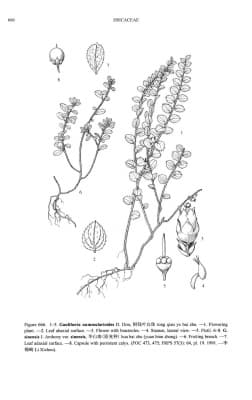
Gaultheria nummularioides
Gaultheria nummularioides
Safety & Hazards
None known
Cultivation Details
Gaultheria nummularioides is a plant of moderate to high elevations in the tropics and subtropics. It only tolerates light and short-lived frosts[1]. It can be grown outdoors in the milder regions of the temperate zone[1]. It is said to not often fruit well in Britain[2], though the single plant in our garden in Cornwall, England (hardiness zone 8 - 9) flowered freely when less than 3 years old from seed, producing quite a few fruits[PFAF]. Prefers a moist but not boggy humus rich soil in shade or semi-shade[3]. A peat and moisture loving species, it requires a lime-free soil[3] and a sheltered position[4]. The bruised leaves have a distinct cedar-like aroma[5]. The flowers are also aromatic[5]. Plants in this genus are notably resistant to honey fungus[1].
Propagation
The seed requires a period of cold stratification. Pre-chill for 4 - 10 weeks and surface sow in a lime-free compost in a shady part of the greenhouse and keep moist[6]. The seed usually germinates well, usually within 1 - 2 months at 20°c, but the seedlings are liable to damp off. Watering them with care and making sure they get ample ventilation will reduce this risk. Watering them with a garlic infusion can help to prevent damping off[PFAF]. Prick out the seedlings into individual pots when they are about 25mm tall and grow them on in light shade in the greenhouse for at least their first winter[PFAF]. Plant them out in late spring or early summer. The seedlings are susceptible to spring frosts and so it might be wise to give them some protection in their first spring or two outdoors.. Cuttings of half-ripe wood 3 - 6cm long, mid summer in a frame in a shady position. They form roots in late summer or spring[6]. A good percentage usually take. Division in spring just before new growth begins. 'Drop' the plants 12 months earlier by digging them up and replanting them deeper in the soil so that the branches are buried and can form roots. This works best in a sandy soil[6]. It is best to pot up the divisions and grow them on in a lightly shaded position in the greenhouse until they are established. Plant them out in the summer. Layering in September/early autumn. Takes 12 months[6]. Cite as: Temperate Plants Database, Ken Fern. temperate.theferns.info. 2026-02-21. <temperate.theferns.info/plant/Gaultheria+nummularioides>
Pollinators
Insects
References
- [1]The New RHS Dictionary of Gardening. 1992. — Huxley. A. · MacMillan Press · 1992 · ISBN 0-333-47494-5 ↩︎Excellent and very comprehensive, though it contains a number of silly mistakes. Readable yet also very detailed.
- [2]The RHS Gardener's Encyclopedia of Plants and Flowers — Brickell. C. · Dorling Kindersley Publishers Ltd. · 1990 · ISBN 0-86318-386-7 ↩︎Excellent range of photographs, some cultivation details but very little information on plant uses.
- [3]Ornamental Shrubs, Climbers and Bamboos. — Thomas. G. S. · Murray · 1992 · ISBN 0-7195-5043-2 ↩︎Contains a wide range of plants with a brief description, mainly of their ornamental value but also usually of cultivation details and varieties.
- [4]Trees and Shrubs Hardy in Great Britain. Vol 1 - 4 and Supplement. — Bean. W. · Murray · 1981 · ISBN - ↩︎A classic with a wealth of information on the plants, but poor on pictures.
- [5]Scented Flora of the World. — Genders. R. · Robert Hale. London. · 1994 · ISBN 0-7090-5440-8 ↩︎An excellent, comprehensive book on scented plants giving a few other plant uses and brief cultivation details. There are no illustrations.
- [6]Propagation of Trees, Shrubs and Conifers. — Sheat. W. G. · MacMillan and Co · 1948 · ISBN - ↩︎A bit dated but a good book on propagation techniques with specific details for a wide range of plants.
- [7]Flora of China — Missouri Botanical Garden Press; St. Louis. · 1994 · http://flora.huh.harvard.edu/china/ ↩︎An excellent, comprehensive resource in 25 volumes. In addition to the botanical information the flora also gives basic information on habitat and some uses. An on-line version is also available.
- [8]Flowers of the Himalayas. — Polunin. O. and Stainton. A. · Oxford Universtiy Press · 1984 · ISBN - ↩︎A very readable and good pocket guide (if you have a very large pocket!) to many of the wild plants in the Himalayas. Gives many examples of plant uses.
- [9]Plants for Human Consumption. — Kunkel. G. · Koeltz Scientific Books · 1984 · ISBN 3874292169 ↩︎An excellent book for the dedicated. A comprehensive listing of Latin names with a brief list of edible parts.
- [10]Plants and People of Nepal — Manandhar. N. P. · Timber Press. Oregon. · 2002 · ISBN 0-88192-527-6 ↩︎Excellent book, covering over 1,500 species of useful plants from Nepal together with information on the geography and peoples of Nepal. Good descriptions of the plants with terse notes on their uses.
- [PFAF]Plants for a Future — pfaf.org ↩︎