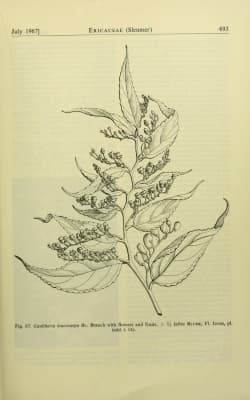
Gaultheria leucocarpa
Gaultheria leucocarpa
Safety & Hazards
The essential oil has GRAS (generally recognised as safe) status in America, when used in very small quantities[1]. However, when it is taken in large amounts methyl salicylate (the main constituent of the oil) is toxic and causes problems similar to those caused by high doses of aspirin[1].
Cultivation Details
A plant of higher elevations in the tropics, found at elevations of 500 - 3,000 metres[2]. Prefers a moist but not boggy humus rich soil in shade or semi-shade[3]. A peat and moisture loving species, it requires a lime-free soil[3]. Plants can flower and fruit all year round in the tropics[1]. Gaultheria leucocarpa yunnanensis (Franch.) T.Z.Hsu & R. C. Fang is the form most utilized for its salicylic acid in China[2]. Plants in this genus are notably resistant to honey fungus[4].
Propagation
The seed requires a period of cold stratification. Pre-chill for 4 - 10 weeks and then surface sow in a lime-free compost in a shady part of the greenhouse and keep the compost moist[5]. The seed usually germinates well, usually within 1 - 2 months at 20°c, but the seedlings are liable to damp off. It is important to water them with care and to ensure that they get plenty of ventilation. Watering them with a garlic infusion can also help to prevent damping of[PFAF]. Prick out the seedlings into individual pots when they are about 25mm tall and grow them on in light shade in the greenhouse for at least their first winter[PFAF]. Plant them out in late spring or early summer. The seedlings are susceptible to spring frosts so might need some protection for their first few years outdoors. The leaves remain very small for the first few years[3]. Cuttings of half-ripe wood 3 - 6cm long, July/August in a frame in a shady position. They form roots in late summer or spring[5]. A good percentage usually take. Division in spring just before new growth begins[4]. Larger clumps can be replanted direct into their permanent positions, though it is best to pot up smaller clumps and grow them on in a cold frame until they are rooting well. Plant them out in the spring. Layering. Cite as: Temperate Plants Database, Ken Fern. temperate.theferns.info. 2026-02-21. <temperate.theferns.info/plant/Gaultheria+leucocarpa>
Pollinators
Insects, Self
References
- [1]Plant Resources of Southeast Asia — http://proseanet.org/ ↩︎Lots of information on the uses of the plants of SE Asia.
- [2]Flora of China — Missouri Botanical Garden Press; St. Louis. · 1994 · http://flora.huh.harvard.edu/china/ ↩︎An excellent, comprehensive resource in 25 volumes. In addition to the botanical information the flora also gives basic information on habitat and some uses. An on-line version is also available.
- [3]Trees and Shrubs Hardy in Great Britain. Vol 1 - 4 and Supplement. — Bean. W. · Murray · 1981 · ISBN - ↩︎A classic with a wealth of information on the plants, but poor on pictures.
- [4]The New RHS Dictionary of Gardening. 1992. — Huxley. A. · MacMillan Press · 1992 · ISBN 0-333-47494-5 ↩︎Excellent and very comprehensive, though it contains a number of silly mistakes. Readable yet also very detailed.
- [5]Propagation of Trees, Shrubs and Conifers. — Sheat. W. G. · MacMillan and Co · 1948 · ISBN - ↩︎A bit dated but a good book on propagation techniques with specific details for a wide range of plants.
- [6]Plants for Human Consumption. — Kunkel. G. · Koeltz Scientific Books · 1984 · ISBN 3874292169 ↩︎An excellent book for the dedicated. A comprehensive listing of Latin names with a brief list of edible parts.
- [7]A Barefoot Doctors Manual. — ? · Running Press; Philadelphica. · 1977 · ISBN 0-914294-92-X ↩︎A very readable herbal from China, combining some modern methods with traditional chinese methods.
- [PFAF]Plants for a Future — pfaf.org ↩︎