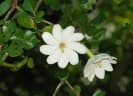
Gardenia thunbergia
Gardenia thunbergia
Safety & Hazards
None known
Cultivation Details
A plant of the subtropics to the tropics, growing in areas with seasonal rainfall. Mature plants can tolerate temperatures down to -1°c, although young plants will require protection from frost An easily grown plant, growing best in sun or semi-shade[1]. Prefers a slightly acid, light, well-drained soil with plenty of organic matter added and regular deep watering[1]. Plants are moderately drought tolerant, though drought stress can cause buds to fall before opening[1]. A slow growing plant[1]. It generally needs little pruning, when required it should be done after flowering or just before the new growth appears[1]. The fruits are hard and woody, and heavily fibrous inside. Each fruit is egg-shaped, greyish green, 50 - 75mm long and 35mm wide, when mature they are roughly dotted with whitish encrustations[1]. The fruits do not burst or split open, or drop, and can remain on the bush for years. They are adapted to being eaten by elephants, large antelope and buffalo, and the seed coats are tough enough to pass through their digestive systems unscathed. Unless people intervene, the seeds will not be released from the fruits and dispersed unless these animals eat them[1]. Harvesting the seed is hard work. Secateurs are soon blunted when cutting the fruits from the plant, You need to use hammers, or any heavy, blunt instrument in order to break the fruits open, and nails and heavy duty spoons to scoop the seeds out. It is heavy, laborious, unpopular work![1].
Propagation
Seed - can be sown in spring to early summer, even in late summer if your winters are mild. Germination should take 4 -6 weeks[1]. Cuttings can be taken at any time of the year, but best results are obtained in the growing season. Rooting of cuttings is best under mist, using a 100-120 mm piece of young (approx. 2 month old) growth with 2 or 3 sets of leaves. There is no need to remove the leaves as it appears to slow the rooting process down[1]. Truncheon cuttings are best taken early in the growing season, and placed in well-drained, sandy soil in a cool, shady spot and kept damp but not wet[1]. Cite as: Tropical Plants Database, Ken Fern. tropical.theferns.info. 2026-02-20. <tropical.theferns.info/viewtropical.php?id=Gardenia+thunbergia>
Pollinators
Moths
References
- [1]PlantZAfrica.com — http://www.plantzafrica.com ↩︎An excellent site giving detailed descriptions and uses of many S. African plants.