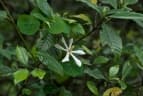
Rubiaceae FAMILY
Gardenia jasminoides
Gardenia jasminoides
Edibility
3/5
Medicinal
3/5
Safety & Hazards
None known
Cultivation Details
HabitEvergreen Shrub
Growth—
Originally a species from warm temperate climates, in tropical areas it grows well, at elevations from 400 - 1,200 metres[1]. It flowers poorly or not at all in tropical lowland areas[1]. Prefers an acidic soil rich in organic matter[2]. Prefers a sunny position[1]. Grows best in a moist but well-drained soil with a pH in the range 6 - 7[3]. Seedling plants can commence flowering when 1 year old[1].
Propagation
Seed - Greenwood cuttings. Cuttings of ripe wood, taken with a heel, in a sandy medium[2]. Cite as: Tropical Plants Database, Ken Fern. tropical.theferns.info. 2026-02-20. <tropical.theferns.info/viewtropical.php?id=Gardenia+jasminoides>
Pollinators
Data unavailable
References
- [1]World Agroforesty Centre — http://www.worldagroforestry.org/ ↩︎An excellent online database of a huge range of trees giving very good information on each plant - its uses, ecology, identity, propagation, pests etc.
- [2]The New RHS Dictionary of Gardening. 1992. — Huxley. A. · MacMillan Press · 1992 · ISBN 0-333-47494-5 ↩︎Excellent and very comprehensive, though it contains a number of silly mistakes. Readable yet also very detailed.
- [3]Plant Resources of Southeast Asia — http://proseanet.org/ ↩︎Lots of information on the uses of the plants of SE Asia.
- [4]Mansfeld's Database of Agricultural and Horticultural Plants — http://mansfeld.ipk-gatersleben.de/pls/htmldb_pgrc/f?p=185:3:4292127278597336 ↩︎Terse details of a huge range of useful plants.
- [5]Dictionary of Economic Plants. — Uphof. J. C. Th. · Weinheim · 1959 · ISBN - ↩︎An excellent and very comprehensive guide but it only gives very short descriptions of the uses without any details of how to utilize the plants. Not for the casual reader.
- [6]Flora of China — Missouri Botanical Garden Press; St. Louis. · 1994 · http://flora.huh.harvard.edu/china/ ↩︎An excellent, comprehensive resource in 25 volumes. In addition to the botanical information the flora also gives basic information on habitat and some uses. An on-line version is also available.
- [7]Cornucopia II — Facciola. S. · Kampong Publications, California. · 1998 · ISBN 0-9628087-2-5 ↩︎The second edition of an excellent guide to the edible uses of plants, though it does not give any details of cultivation etc.
- [8]Perennial Edible Fruits of the Tropics : an Inventory — Martin, F. W.; Campbell, C. W.; Rubertbe, R. M. · U.S. Dept. of Agriculture, Agricultural Research Service · 1987 ↩︎A booklet giving terse details of almost 300 species of edible fruits, plus regional lists of Botanical and Common names for over 2,500 less well-known edible fruits of the tropics.
- [9]Indian Medicinal Plants; An Illustrated Dictionary — Khare C.P. (Ed.) · Springer-Verlag Berlin/Heidelberg · 2007 · ISBN 978-0-387-70637-5 ↩︎
- [10]Medicinal Plants in Vietnam — Nguyen Van Dan & Doan Thi Nhu · World Health Organisation · 1989 · ISBN 92 9061 101 4 ↩︎An excellent book, giving information on over 200 plants, their medicinal compounds and applications.