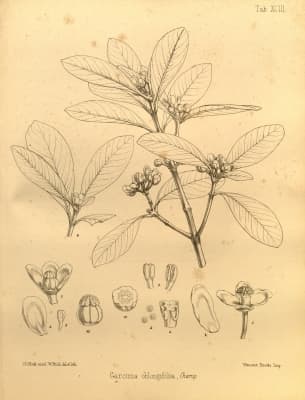
Clusiaceae FAMILY Least Concern
Garcinia oblongifolia
Garcinia oblongifolia
Edibility
3/5
Medicinal
0/5
Safety & Hazards
None known
Cultivation Details
HabitTree
Growth—
A dioecious species, both male and female forms usually need to be grown if fruit and seed are required[1]. At least some dioecious Garcinia species, however, are able to produce fertile seed even in the absence of fertilization (asexual reproduction). Such seeds would be expected to be genetically identical to the parent[2]
Propagation
Seed - we have no specific information on this species, but the seed of most members of the genus can be slow to germinate, even if sown fresh, often taking 6 months or more[PFAF]. Cite as: Tropical Plants Database, Ken Fern. tropical.theferns.info. 2026-02-20. <tropical.theferns.info/viewtropical.php?id=Garcinia+oblongifolia>
Pollinators
Data unavailable
References
- [1]Flora of China — Missouri Botanical Garden Press; St. Louis. · 1994 · http://flora.huh.harvard.edu/china/ ↩︎An excellent, comprehensive resource in 25 volumes. In addition to the botanical information the flora also gives basic information on habitat and some uses. An on-line version is also available.
- [2]Taxonomic Revision of Garcinia Section Garcinia (Clusiaceae) — Nazre M., Newman M.F., Pennington R.T. & Middleton D.J. · 2018 · https://doi.org/10.11646/phytotaxa.373.1.1 · ISBN 1179-3155 ↩︎
- [3]Mansfeld's Database of Agricultural and Horticultural Plants — http://mansfeld.ipk-gatersleben.de/pls/htmldb_pgrc/f?p=185:3:4292127278597336 ↩︎Terse details of a huge range of useful plants.
- [4]IUCN Red List of Threatened Species — http://www.iucnredlist.org/ ↩︎A list of plants under threat and facing possible extinction, usually with brief details of the threats and information on habitat.
- [PFAF]Plants for a Future — pfaf.org ↩︎