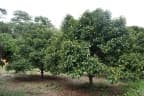
Garcinia mangostana
Garcinia mangostana
Safety & Hazards
None known
Cultivation Details
The mangosteen is an ultra-tropical plant, usually only grown in areas without a dry season and within 10 degrees of the equator. It is usually grown from sea level up to 1,000 metres elevation, but the growth rate is higher in lowland areas[1, 2]. It grows best in areas where annual daytime temperatures are within the range 20 - 30°c, but can tolerate 15 - 40°c[2]. It cannot tolerate temperatures below 4°c, nor above 38°c[1]. It prefers a mean annual rainfall in the range 1,600 - 2,000mm, but tolerates 1,100 - 2,800mm[2]. Succeeds in full sun and in light shade[2]. Requires a good, deep, rich organic soil that retains moisture but is also well-drained[3]. Grows best in a fertile clay with good drainage[4]. Prefers an acid soil[5]. Prefers a pH in the range 5 - 6, tolerating 4.3 - 7.5[2]. Plants are intolerant of drought[3]. The mangosteen must be sheltered from strong winds and salt spray[1]. It takes at least 8 years before a tree commences bearing fruit, but yields of 200 - 1,500 fruits per tree have been recorded from mature specimens[4]. In cooler climates it can take 15 - 20 years for plants to produce their first fruit from seed[3]. Trees produce an economical yield of fruit for about 50 years[2]. Stress should be avoided; a tree which is visibly suffering seldom recovers[1]. Plants resent root disturbance[4]. Only female forms of this plant are known, but they are able to produce fruit without fertilization[4]. There are some named forms[6]. The plants grow very well when banana plants are grown around them to provide wind shelter and plenty of mulch material[3]. Some of the most fruitful mangosteen trees grow on the banks of streams, lakes, ponds or canals where the roots are almost constantly wet. However, dry weather just before blooming time and during flowering induces a good fruit-set[1].
Propagation
Seed. - it has a very short viability and should be sown as soon as it is ripe[1]. Technically, the so-called 'seeds' are not true seeds but adventitious embryos, or hypocotyl tubercles; there has been no sexual fertilization[1]. When growth begins, a shoot emerges from one end of the seed and a root from the other end. But this root is short-lived and is replaced by roots which develop at the base of the shoot. The process of reproduction being vegetative, there is naturally little variation in the resulting trees and their fruits[1]. Some of the seeds are polyembryonic, producing more than one shoot. The individual nucellar embryos can be separated, if desired, before planting[1]. The percentage of germination is directly related to the weight of the seed, only plump, fully developed seeds should be chosen for planting[1]. Because of the long, delicate taproot and poor lateral root development, transplanting is notoriously difficult. It must not be attempted after the plants reach 60cm[1]. At that time the depth of the taproot may exceed the height of the plant[1]. There is greater seedling survival if seeds are planted directly in the nursery row than if first grown in containers and then transplanted to the nursery[1]. The nursery soil should be 1 metre deep, at least. The young plants take 2 years or more to reach a height of 30cm, when they can be taken up with a deep ball of earth and set out[1]. Seeds are recalcitrant and should be stored in their fruit at room temperature, or in moist peat moss, even these will lose viability in 5 days after removal from the fruit, though they are viable for 3 - 5 weeks in the fruit. Viability can be maintained for 1 - 2 months in moist storage at 20°c, storage temperature of 10°c is damaging[1]. Cuttings of greenwood. Budding on to seedlings[4]. Cite as: Tropical Plants Database, Ken Fern. tropical.theferns.info. 2026-02-20. <tropical.theferns.info/viewtropical.php?id=Garcinia+mangostana>
Pollinators
Data unavailable
References
- [1]World Agroforesty Centre — http://www.worldagroforestry.org/ ↩︎An excellent online database of a huge range of trees giving very good information on each plant - its uses, ecology, identity, propagation, pests etc.
- [2]Ecocrop — http://ecocrop.fao.org/ecocrop/srv/en/home ↩︎Basic information on a wide range of useful plants, plus details of environmental needs where available.
- [3]Tropical Food Gardens — Norrington. L. · Bloomings Books (Melbourne) · 2001 · ISBN 1-876473-41-x ↩︎Excellent little book giving some basic information on a range of plants.
- [4]The New RHS Dictionary of Gardening. 1992. — Huxley. A. · MacMillan Press · 1992 · ISBN 0-333-47494-5 ↩︎Excellent and very comprehensive, though it contains a number of silly mistakes. Readable yet also very detailed.
- [5]Tropical and Subtropical Trees - A Worldwide Encyclopaedic Guide. — Barwick. M. · Thames & Hudson, London · 2004 · ISBN 0-500-51181-0 ↩︎A superb book, very concise and well written, giving a wealth of information on 400 or more species including descriptions, habitat, cultivation details and plant uses. A wealth of colour photographs bring each plant vividly to life.
- [6]Cornucopia II — Facciola. S. · Kampong Publications, California. · 1998 · ISBN 0-9628087-2-5 ↩︎The second edition of an excellent guide to the edible uses of plants, though it does not give any details of cultivation etc.
- [7]Digital Compendium of Forestry Species of Cambodia — www.digitalspecies.blogspot.com; Phnom Penh · 2008 · http://www.digitalspecies.blogspot.com ↩︎A very detailed booklet, produced in PDF format on the internet, giving information on around 100 species of trees.
- [8]Plants of Southeast Asia — http://www.asianplant.net/ ↩︎Excellent site with brief information on the plant, its range, habitat and uses, plus phots of specimens, close-ops of flowers and leaves etc,
- [9]Flowering Plants of Jamaica — Adams. C.D. · University of the West Indies; Jamaica. · 1972 ↩︎A terse treatment of the flowering plants of Jamaica, with a botanical description of each plant, notes on habitat etc.
- [10]Brazilian Fruits and Cultivated Exotics — Lorenzi. H.; Bacher. L.; Lacerda. M.; Sartori. S. · Instituto Plantarum De Estudos Da Flora LTDA; Brazil. · 2000 · ISBN 85-867174-24-0 ↩︎A superb book, giving information on several hundred fruit species. Each entry has a brief description of the plant and its uses, accompanied by one to many excellent quality photographs of the fruits.
- [11]Glossary of Indian Medicinal Plants (Including the Supplement). — Chopra. R. N., Nayar. S. L. and Chopra. I. C. · Council of Scientific and Industrial Research, New Delhi. · 1986 · ISBN - ↩︎Very terse details of medicinal uses of plants with a wide range of references and details of research into the plants chemistry. Not for the casual reader.
- [12]Minor Products of Philippine Forests — Brown. W. H. · Bureau of Forestry, Manilla. · 1920 ↩︎A useful guide to some of the plants of the area, though terse on details. The book is out of copyright and can be legally downloaded from the Internet.
- [13]CosIng — http://ec.europa.eu/growth/tools-databases/cosing/ ↩︎CosIng is the European Commission database for information on cosmetic substances and ingredients.
- [14]Trees Commonly Cultivated in SE Asia — Jensen. M. · FAO Regional Office, Bangkok. · 1999 · ISBN 974-89377-5-5 ↩︎