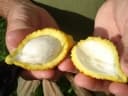
Garcinia madruno
Garcinia madruno
Safety & Hazards
None known
Cultivation Details
A plant of the hot, humid tropical lowlands[1]. Succeeds in full sun or light shade[2]. Plants are tolerant of occasional inundation[2]. Newly planted young trees establish well and grow away fairly quickly[2]. A dioecious species, both male and female forms usually need to be grown if fruit and seed are required. At least some dioecious Garcinia species, however, are able to produce fertile seed even in the absence of fertilization (asexual reproduction). Such seeds would be expected to be genetically identical to the parent[3]
Propagation
Seed - best sown as soon as it is ripe in a semi-shaded position in a nursery seedbed. Germination rates in excess of 70% are usually achieved, with the seed sprouting within 60 - 70 days[2]. Cite as: Tropical Plants Database, Ken Fern. tropical.theferns.info. 2026-02-20. <tropical.theferns.info/viewtropical.php?id=Garcinia+madruno>
Pollinators
Data unavailable
References
- [1]Perennial Edible Fruits of the Tropics : an Inventory — Martin, F. W.; Campbell, C. W.; Rubertbe, R. M. · U.S. Dept. of Agriculture, Agricultural Research Service · 1987 ↩︎A booklet giving terse details of almost 300 species of edible fruits, plus regional lists of Botanical and Common names for over 2,500 less well-known edible fruits of the tropics.
- [2]Brazilian Trees. Volume 3. — Lorenzi. H. · Instituto Plantarum De Estudos Da Flora; Brazil. · 2009 · ISBN 85-86714-34-4 ↩︎Information on 350 species of Brazilian trees. Stunning photographs of each species, brief details on the plant, its uses and how to grow it from seed. A superb work, with the minor irritation that the translation from Portuguese is not of the best.
- [3]Taxonomic Revision of Garcinia Section Garcinia (Clusiaceae) — Nazre M., Newman M.F., Pennington R.T. & Middleton D.J. · 2018 · https://doi.org/10.11646/phytotaxa.373.1.1 · ISBN 1179-3155 ↩︎
- [4]Fruits of Warm Climates — Morton. J. · Florida Flair books, Florida. · 1987 · ISBN 0961018410 ↩︎A very well written guide to about 125 species.
- [5]Illustrated Guide to the Trees of Peru — Pennington, T.D.; Reynel, C. & Daza, A. · David Hunt; Sherbourne, England. · 2004 · ISBN 0 9538134 3 6 ↩︎A very terse guide to the trees of Peru, managing to give basic guides to a large number of genera, with more detail on a few species in each genus.
- [6]Brazilian Fruits and Cultivated Exotics — Lorenzi. H.; Bacher. L.; Lacerda. M.; Sartori. S. · Instituto Plantarum De Estudos Da Flora LTDA; Brazil. · 2000 · ISBN 85-867174-24-0 ↩︎A superb book, giving information on several hundred fruit species. Each entry has a brief description of the plant and its uses, accompanied by one to many excellent quality photographs of the fruits.
- [7]Dictionary of Economic Plants. — Uphof. J. C. Th. · Weinheim · 1959 · ISBN - ↩︎An excellent and very comprehensive guide but it only gives very short descriptions of the uses without any details of how to utilize the plants. Not for the casual reader.
- [8]Cornucopia II — Facciola. S. · Kampong Publications, California. · 1998 · ISBN 0-9628087-2-5 ↩︎The second edition of an excellent guide to the edible uses of plants, though it does not give any details of cultivation etc.
- [9]Contributions from the United States National Herbarium Vol. 27 — Standley P.C. · Smithsonian Institute; Washington. · 1928 · http://www.biodiversitylibrary.org ↩︎Contains a Flora of the Panama Canal zone
- [10]Tropical Timbers of the World. Ag. Handbook No. 607. — Chudnoff. Martin. · USDA Forest Service. Wisconsin. · 1984 ↩︎Terse details on the properties of the wood of almost 400 species of trees from the Tropics.