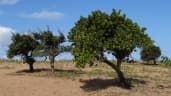
Garcinia livingstonei
Garcinia livingstonei
Safety & Hazards
The yellow oily sap is used to manufacture arrow poison and decorate arrows[1].
Cultivation Details
A plant of low to medium elevations in hot, dry, tropical climates, it also succeeds in more humid areas[2]. In Tanzania, the plant is found growing in areas where the mean annual rainfall is in the range 800 - 1,800mm[3]. Succeeds in both full sun and partial shade[4]. Prefers a sandy loam[3]. Trees tolerate a wide variety of soil conditions and are salt tolerant so they can be grown near the ocean[4]. A slow-growing tree[4]. Seedling plants can commence producing fruit when 4 - 6 years old, whilst grafted plants can fruit when 2 - 3 years old[2]. The flowers are much visited by bees[5]. A dioecious species, both male and female forms usually need to be grown if fruit and seed are required[6]. At least some dioecious Garcinia species, however, are able to produce fertile seed even in the absence of fertilization (asexual reproduction). Such seeds would be expected to be genetically identical to the parent[7]
Propagation
Seed - best sown as soon as it is ripe[3]. We have no specific information on this species, but the seed of most members of the genus can be slow to germinate, even if sown fresh, often taking 6 months or more[PFAF]. Grafting. Cite as: Tropical Plants Database, Ken Fern. tropical.theferns.info. 2026-02-20. <tropical.theferns.info/viewtropical.php?id=Garcinia+livingstonei>
Pollinators
Bees
References
- [1]World Agroforesty Centre — http://www.worldagroforestry.org/ ↩︎An excellent online database of a huge range of trees giving very good information on each plant - its uses, ecology, identity, propagation, pests etc.
- [2]Perennial Edible Fruits of the Tropics : an Inventory — Martin, F. W.; Campbell, C. W.; Rubertbe, R. M. · U.S. Dept. of Agriculture, Agricultural Research Service · 1987 ↩︎A booklet giving terse details of almost 300 species of edible fruits, plus regional lists of Botanical and Common names for over 2,500 less well-known edible fruits of the tropics.
- [3]Edible Wild Plants of Tanzania — Ruffo, C.K.: Birnie, A. & Tengnas, B. · Regional Land Management Unit; Nairobi. · 2002 · ISBN 9966-896-60-0 ↩︎A very well presented, simple guide to growing and utilizing wild food plants in Tanzania, with line drawings of each plant, a description, habitat and range, non-food as well as food uses, plus basic information on growing the plants.
- [4]Trade Winds Fruit — http://www.tradewindsfruit.com/index.htm ↩︎The on-line catalogue of a company selling seeds. Gives descriptions, photos and uses of a very wide range of fruit and other food-producing plants plus ornamentals.
- [5]The Useful Plants of West Tropical Africa. — Burkil. H. M. · Royal Botanic Gardens; Kew. · 1985 - 2004 ↩︎Brief descriptions and details of the uses of over 4,000 plants. A superb, if terse, resource, it is also available electronically on the Web - see http://www.aluka.org/
- [6]Contribution to the taxonomy of Garcinia (Clusiaceae) in Africa, including two new species from Gabon and a key to t — Marc S.M. Sosef, Gilles Dauby · 2012 · http://www.phytokeys.com ↩︎
- [7]Taxonomic Revision of Garcinia Section Garcinia (Clusiaceae) — Nazre M., Newman M.F., Pennington R.T. & Middleton D.J. · 2018 · https://doi.org/10.11646/phytotaxa.373.1.1 · ISBN 1179-3155 ↩︎
- [8]African Flowering Plants Database — Conservatoire et Jardin Botaniques. · http://www.ville-ge.ch/musinfo/bd/cjb/africa/recherche.php ↩︎Contains information on over 150,000 plant names (including synonyms) giving a description and habitat, plus a distribution map.
- [9]Mansfeld's Database of Agricultural and Horticultural Plants — http://mansfeld.ipk-gatersleben.de/pls/htmldb_pgrc/f?p=185:3:4292127278597336 ↩︎Terse details of a huge range of useful plants.
- [10]Brazilian Fruits and Cultivated Exotics — Lorenzi. H.; Bacher. L.; Lacerda. M.; Sartori. S. · Instituto Plantarum De Estudos Da Flora LTDA; Brazil. · 2000 · ISBN 85-867174-24-0 ↩︎A superb book, giving information on several hundred fruit species. Each entry has a brief description of the plant and its uses, accompanied by one to many excellent quality photographs of the fruits.
- [11]Cornucopia II — Facciola. S. · Kampong Publications, California. · 1998 · ISBN 0-9628087-2-5 ↩︎The second edition of an excellent guide to the edible uses of plants, though it does not give any details of cultivation etc.
- [PFAF]Plants for a Future — pfaf.org ↩︎