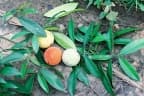
Garcinia kola
Garcinia kola
Safety & Hazards
None known
Cultivation Details
Plantation cultivation can be successfully carried out: three year old stump-planting under shade is recommended, but sowing the seed in situ by a stake is possible[1]. A dioecious species, both male and female forms usually need to be grown if fruit and seed are required[2]. At least some dioecious Garcinia species, however, are able to produce fertile seed even in the absence of fertilization (asexual reproduction). Such seeds would be expected to be genetically identical to the parent[3]
Propagation
Seed - it has a short viability and so should be sown as soon as possible. The fresh, mature seeds are dormant but viable, creating difficulties with rapid and uniform germination within seed lots. The thin leathery seed cover is not a barrier to water penetration in the embryo, however, de-coating or ethanol treatments (soaking in 70% ethanol solution for 1 to 2 hours) can increase germination to more than 90% after about 5 months[4]. Germination of intact, fresh seeds is about 50%, starting after about 3 months at ambient temperature (25 - 28°c) and most seeds will have germinated 7 - 8 months after sowing (in river sand)[4]. However, in nursery trials, the seeds continued to germinate for 18 months, reaching a final germination level of 75%[4]. Cite as: Tropical Plants Database, Ken Fern. tropical.theferns.info. 2026-02-20. <tropical.theferns.info/viewtropical.php?id=Garcinia+kola>
Pollinators
Data unavailable
References
- [1]The Useful Plants of West Tropical Africa. — Burkil. H. M. · Royal Botanic Gardens; Kew. · 1985 - 2004 ↩︎Brief descriptions and details of the uses of over 4,000 plants. A superb, if terse, resource, it is also available electronically on the Web - see http://www.aluka.org/
- [2]Contribution to the taxonomy of Garcinia (Clusiaceae) in Africa, including two new species from Gabon and a key to t — Marc S.M. Sosef, Gilles Dauby · 2012 · http://www.phytokeys.com ↩︎
- [3]Taxonomic Revision of Garcinia Section Garcinia (Clusiaceae) — Nazre M., Newman M.F., Pennington R.T. & Middleton D.J. · 2018 · https://doi.org/10.11646/phytotaxa.373.1.1 · ISBN 1179-3155 ↩︎
- [4]Seed Leaflets — Various · Forest & Landscape. Denmark · http://en.sl.life.ku.dk/Publikationer/Udgivelser/PopulaerPublikationer.aspx?katid={D28373CC-6EF3-4EF8-B097-6D83FABF209E}&serieid={9F1C3DB1-6E7B-4CF1-AF53-F480B0CB40EF}&sort=title ↩︎A series of leaflets, jointly produced by the University of Copenhagen and the Royal Botanic Gardens at Kew, focussing on seed information for a number species, but also giving a lot of other information about each plant.
- [5]Cornucopia II — Facciola. S. · Kampong Publications, California. · 1998 · ISBN 0-9628087-2-5 ↩︎The second edition of an excellent guide to the edible uses of plants, though it does not give any details of cultivation etc.
- [6]IUCN Red List of Threatened Species — http://www.iucnredlist.org/ ↩︎A list of plants under threat and facing possible extinction, usually with brief details of the threats and information on habitat.
- [7]CosIng — http://ec.europa.eu/growth/tools-databases/cosing/ ↩︎CosIng is the European Commission database for information on cosmetic substances and ingredients.