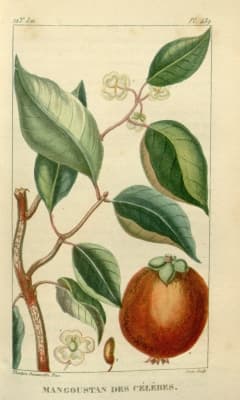
Garcinia celebica
Garcinia celebica
Safety & Hazards
None known
Cultivation Details
Grows well in dappled shade[1]. The tree resembles the mangosteen (Garcinia mangostana), but its latex is white and the flowers are smaller[2]. This species has been suggested for breeding with other members of the genus in order to improve their fruiting qualities[3]. A dioecious species, both male and female forms usually need to be grown if fruit and seed are required[1, 4]. At least some dioecious Garcinia species, however, are able to produce fertile seed even in the absence of fertilization (asexual reproduction). Such seeds would be expected to be genetically identical to the parent[5]
Propagation
Seed - we have no specific information on this species, but the seed of most members of the genus can be slow to germinate, even if sown fresh, often taking 6 months or more[PFAF]. Cite as: Tropical Plants Database, Ken Fern. tropical.theferns.info. 2026-02-20. <tropical.theferns.info/viewtropical.php?id=Garcinia+celebica>
Pollinators
Data unavailable
References
- [1]Online Guide to Chek Jawa — http://www.wildsingapore.com/chekjawa/index.html ↩︎Brief fact sheets on some of the plants growing in the Mangrove swamps and along the adjoining shore line.
- [2]Plant Resources of Southeast Asia — http://proseanet.org/ ↩︎Lots of information on the uses of the plants of SE Asia.
- [3]Mansfeld's Database of Agricultural and Horticultural Plants — http://mansfeld.ipk-gatersleben.de/pls/htmldb_pgrc/f?p=185:3:4292127278597336 ↩︎Terse details of a huge range of useful plants.
- [4]Flore Forestière de la Cochinchine — Pierre L. · 1883-1889 · http://www.biodiversitylibrary.org/ ↩︎Written in French and, although rather dated, remains an excellent reference for woody plants from IndoChina. There is a description of the plant, often followed by a resumé of uses, and some truly excellent line drawings.
- [5]Taxonomic Revision of Garcinia Section Garcinia (Clusiaceae) — Nazre M., Newman M.F., Pennington R.T. & Middleton D.J. · 2018 · https://doi.org/10.11646/phytotaxa.373.1.1 · ISBN 1179-3155 ↩︎
- [6]Trees of Sungai Wain — http://www.nationaalherbarium.nl/Sungaiwain/ ↩︎An excellent site with factsheets on almost 1,000 species of forest trees growing at Sungai Wain in Indonesia. Each factsheet has good quality pictures plus basic information on the ecology and uses of the plants.
- [7]Cornucopia II — Facciola. S. · Kampong Publications, California. · 1998 · ISBN 0-9628087-2-5 ↩︎The second edition of an excellent guide to the edible uses of plants, though it does not give any details of cultivation etc.
- [8]Contribution to the taxonomy of Garcinia (Clusiaceae) in Africa, including two new species from Gabon and a key to t — Marc S.M. Sosef, Gilles Dauby · 2012 · http://www.phytokeys.com ↩︎
- [9]Dictionary of Economic Plants. — Uphof. J. C. Th. · Weinheim · 1959 · ISBN - ↩︎An excellent and very comprehensive guide but it only gives very short descriptions of the uses without any details of how to utilize the plants. Not for the casual reader.
- [10]Glossary of Indian Medicinal Plants (Including the Supplement). — Chopra. R. N., Nayar. S. L. and Chopra. I. C. · Council of Scientific and Industrial Research, New Delhi. · 1986 · ISBN - ↩︎Very terse details of medicinal uses of plants with a wide range of references and details of research into the plants chemistry. Not for the casual reader.
- [11]A Manual of Indian Timbers. — Gamble. J. S. · Bishen Singh Mahendra Pal Singh · 1972 · ISBN - ↩︎First written in the 19th century, but still a classic, giving a lot of information on the uses and habitats of Indian trees. Not for the casual reader.
- [PFAF]Plants for a Future — pfaf.org ↩︎