Cultivation Details
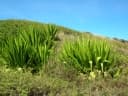
A plant of the tropics. It grows best in areas where annual daytime temperatures are within the range 23 - 30°c, but can tolerate 16 - 34°c[2]. It prefers a mean annual rainfall in the range 1,000 - 2,100mm, but tolerates 700 - 2,500mm[2]. Requires a well-drained, medium to light soil and a sunny position[3, 2]. Prefers a pH in the range 6 - 7, tolerating 5.5 - 8[2]. Very drought tolerant, the plant is able to withstand a dry season of 8 months[2]. The plant has escaped from cultivation in some areas - in New Caledonia it has become a noxious weed[4]. The plants inflorescences produce bulblets in large quantities; these disperse naturally and form dense impenetrable stands which exclude native vegetation[5]. The plant takes 3 - 4 years before its first harvest, and thereafter it can be harvested every 2 - 3 years[2]. It has a total life span of 7 - 10 years[2]. Yields of between 60 - 90 tonnes/ha of green leaf can be obtained every other year, which compares to 2 - 3 tonnes of dry fibre[2]. Plants are monocarpic - they live for a number of years without flowering, then put all their energy into flowering and die afterwards[3].
Propagation
Seed - rarely produced[3]. Plants frequently produce large numbers of bulbils, which root and grow into new plants when they fall to the ground[3]. These bulbils have the capacity to remain viable for a number of years, even in unfavourable conditions[3]. Cite as: Tropical Plants Database, Ken Fern. tropical.theferns.info. 2026-02-20. <tropical.theferns.info/viewtropical.php?id=Furcraea+foetida>
Pollinators
Data unavailable
References
- [1]Medicinal Plants of the Guianas — DeFilipps, R. A.; Maina, S. L.; & Crepin, J. · Smithsonian Museum · http://botany.si.edu/bdg/medicinal/index.html ↩︎A down-loadable PDF document of a book in pre-publication awaiting illustration. An excellent, if rather terse, guide to the traditional medicinal uses of the plants of the region
- [2]Ecocrop — http://ecocrop.fao.org/ecocrop/srv/en/home ↩︎Basic information on a wide range of useful plants, plus details of environmental needs where available.
- [3]The New RHS Dictionary of Gardening. 1992. — Huxley. A. · MacMillan Press · 1992 · ISBN 0-333-47494-5 ↩︎Excellent and very comprehensive, though it contains a number of silly mistakes. Readable yet also very detailed.
- [4]Mansfeld's Database of Agricultural and Horticultural Plants — http://mansfeld.ipk-gatersleben.de/pls/htmldb_pgrc/f?p=185:3:4292127278597336 ↩︎Terse details of a huge range of useful plants.
- [5]Global Invasive Species Database — http://www.issg.org/database/welcome/ ↩︎Very detailed information on almost 400 species (with more being added) of plants that have become weeds in areas outside their native range.
- [6]Dictionary of Economic Plants. — Uphof. J. C. Th. · Weinheim · 1959 · ISBN - ↩︎An excellent and very comprehensive guide but it only gives very short descriptions of the uses without any details of how to utilize the plants. Not for the casual reader.
- [PFAF]Plants for a Future — pfaf.org ↩︎