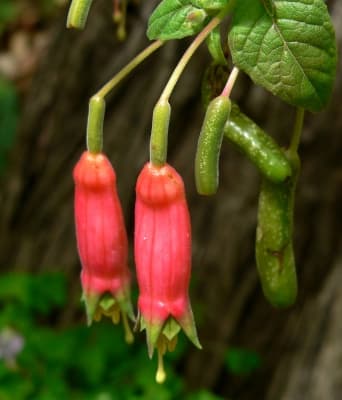
Fuchsia splendens
Fuchsia splendens
Safety & Hazards
None known
Cultivation Details
Fuchsia splendens is only hardy in the mildest parts of the temperate zone. It can grow well in Cornwall and south Devon in the UK (hardiness zone 8) when well sited - it is usualy cut back to ground level by frosts but will usually resprout from the base in the spring, especially if the plant has been given a generous organic mulch. A plant at Trengwainton in Cornwall growing out of a shady wall was about 2 metres tall and fruiting heavily in early August 1995[PFAF]. The young growth in spring, even on mature plants, is frost-tender and so it is best to grow the plants in a position sheltered from the early morning sun[PFAF]. Succeeds in any fertile well-drained circum-neutral soil[1]. Succeeds in a good loam if sand and leafmold are added[2]. A very adaptable plant, it tolerates the heavy shade of a north-facing wall and also a position in full sun, though the foliage is apt to be somewhat pale when plants grow in full sun[3]. Fuchsia species flower and fruit mainly on new wood produced in the same growing season. Any pruning, therefore, is best carried out at the start of the growing season, cutting out old wood in order to encourage vigorous new growth[1]. Plants can flower and fruit for most of the year[4]. Plants are very susceptible to whitefly[5]. Plants seem to be immune to the predations of rabbits[6].
Propagation
Seed - best sown as soon as it is ripe[1] though it can also be sown in the spring[2]. Surface sow the seed in pots in a warm greenhouse and do not allow the compost to dry out[1]. Germination should take place in less than 6 weeks. Prick out the seedlings into individual pots when they are large enough to handle, and grow them on in the greenhouse for at least their first winter. Plant out in late spring or early summer, after the last expected frosts. Inter-nodal cuttings of greenwood, 5 - 8cm long, May/early summer in a frame. Quick and easy, a high percentage take[7, PFAF]. Overwinter in the greenhouse for the first year and plant out after the last expected frosts. Inter-nodal cuttings of half-ripe wood, mid summer in a frame. Very quick and easy, treat as greenwood cuttings above[PFAF]. Cuttings usually succeed at any time during the growing season[PFAF]. Cite as: Temperate Plants Database, Ken Fern. temperate.theferns.info. 2026-02-21. <temperate.theferns.info/plant/Fuchsia+splendens>
Pollinators
Insects
References
- [1]The New RHS Dictionary of Gardening. 1992. — Huxley. A. · MacMillan Press · 1992 · ISBN 0-333-47494-5 ↩︎Excellent and very comprehensive, though it contains a number of silly mistakes. Readable yet also very detailed.
- [2]RHS Dictionary of Plants plus Supplement. 1956 — F. Chittendon. · Oxford University Press · 1951 · ISBN - ↩︎Comprehensive listing of species and how to grow them. Somewhat outdated, it has been replaced in 1992 by a new dictionary (see [ 200 ]).
- [3]The Garden. Volume 111. — RHS. · Royal Horticultural Society · 1986 · ISBN - ↩︎Snippets of information from the magazine of the RHS, including an article on Crambe maritima and another on several species thought to be tender that are succeeding in a S. Devon garden.
- [4]Trade Winds Fruit — http://www.tradewindsfruit.com/index.htm ↩︎The on-line catalogue of a company selling seeds. Gives descriptions, photos and uses of a very wide range of fruit and other food-producing plants plus ornamentals.
- [5]The RHS Gardener's Encyclopedia of Plants and Flowers — Brickell. C. · Dorling Kindersley Publishers Ltd. · 1990 · ISBN 0-86318-386-7 ↩︎Excellent range of photographs, some cultivation details but very little information on plant uses.
- [6]Perennial Garden Plants — Thomas. G. S. · J. M. Dent & Sons, London. · 1990 · ISBN 0 460 86048 8 ↩︎A concise guide to a wide range of perennials. Lots of cultivation guides, very little on plant uses.
- [7]Propagation of Trees, Shrubs and Conifers. — Sheat. W. G. · MacMillan and Co · 1948 · ISBN - ↩︎A bit dated but a good book on propagation techniques with specific details for a wide range of plants.
- [8]Flora of Guatemala — Standley P.C. & J. A. Steyermark · 1946 - 1976 · http://www.archive.org/ ↩︎A superb reference, though somewhat dated. Gives lots of plant uses as well as information on plant habit and habitat. The entire flora (13 volumes) can now be downloaded from http://www.archive.org/
- [9]Annals of the Missouri Botanical Garden Vol. 69 — Missouri Botanical Garden · 1982 ↩︎An excellent botanical publication, available for download from the Internet. This volume contains a treatment of section Fuchsia in the Genus Fuchsia.
- [10]The Garden Volume 123 — Hodgson I. (Editor) · Royal Horticultural Society · 1998 · ISBN 0308-5457 ↩︎Articles on Fuchsia species, cultivars of Blackberries.
- [11]Tanaka's Cyclopedia of Edible Plants of the World. — Tanaka. T. & Nakao S. · Keigaku Publishing; Tokyo · 1976 · ISBN - ↩︎The most comprehensive list of edible plants I've come across. Only the briefest entry for each species, though, and some of the entries are more than a little dubious. Not for the casual reader.
- [12]The Milder Garden. — Taylor. J. · Dent · 1990 ↩︎A good book on plants that you didn't know could be grown outdoors in Britain.
- [PFAF]Plants for a Future — pfaf.org ↩︎