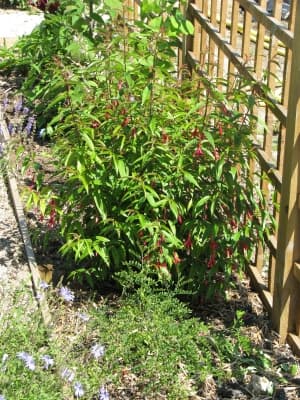
Fuchsia hatschbachii
Fuchsia hatschbachii
Safety & Hazards
None known
Cultivation Details
A plant of the subtropics, occasionally found at higher elevations in tropical areas of Brazil. It is fairly tolerant of cold conditions and is said to be able to tolerate temperatures down to about -10°c[1]. At these temperatures, the top growth is very liable to be cut back to ground level, but the plant resprouts from the base when warmer weather returns[PFAF]. Prefers a position in dappled to deep shade, growing well in a fertile, moist but well-drained soil[1]. Fuchsia species flower and fruit mainly on new wood produced in the same growing season. Any pruning, therefore, is best carried out at the start of the growing season, cutting out old wood in order to encourage vigorous new growth[2].
Propagation
Seed - best sown as soon as it is ripe[2] though stored seed can also be used. Surface sow the seed in a semi-shaded position in a seed tray, gently pressing the seed into the compost, and do not allow the compost to dry out[2]. Germination should take place in less than 6 weeks. Prick out the seedlings into individual pots when they are large enough to handle, and grow them on until large enough to plant out. Inter-nodal cuttings of greenwood, 5 - 8cm long in a frame. Quick and easy, a high percentage take[3, PFAF]. Inter-nodal cuttings of half-ripe wood in a frame. Very quick and easy, treat as greenwood cuttings above[PFAF]. Cuttings usually succeed at any time during the growing season[PFAF]. Cite as: Tropical Plants Database, Ken Fern. tropical.theferns.info. 2026-02-20. <tropical.theferns.info/viewtropical.php?id=Fuchsia+hatschbachii>
Pollinators
Data unavailable
References
- [1]Trade Winds Fruit — http://www.tradewindsfruit.com/index.htm ↩︎The on-line catalogue of a company selling seeds. Gives descriptions, photos and uses of a very wide range of fruit and other food-producing plants plus ornamentals.
- [2]The New RHS Dictionary of Gardening. 1992. — Huxley. A. · MacMillan Press · 1992 · ISBN 0-333-47494-5 ↩︎Excellent and very comprehensive, though it contains a number of silly mistakes. Readable yet also very detailed.
- [3]Propagation of Trees, Shrubs and Conifers. — Sheat. W. G. · MacMillan and Co · 1948 · ISBN - ↩︎A bit dated but a good book on propagation techniques with specific details for a wide range of plants.
- [4]Annals of the Missouri Botanical Garden Vol. 76 — Missouri Botanical Garden · 1989 ↩︎An excellent botanical publication, available for download from the Internet. This volume contains a monograph of the genus Zapoteca (Calliandra) amongst other things.
- [PFAF]Plants for a Future — pfaf.org ↩︎