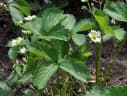
Fragaria × ananassa
Fragaria × ananassa
Safety & Hazards
None known
Cultivation Details
Strawberries are essentially a species of temperate climates, but can be cultivated successfully at elevations above 1,000 metres in tropical latitudes. They grow best in areas where annual daytime temperatures are within the range 11 - 24°c, but can tolerate 6 - 28°c[1]. When dormant, they can survive temperatures down to about -15 to -20°c, but flowers can be severely damaged at -0.5 to -3°c[1]. They prefer a mean annual rainfall in the range 600 - 900mm, but tolerate 300 - 1,700mm[1]. Prefers a fertile, well-drained, moisture retentive soil in a sunny position[2]. Tolerates semi-shade though fruit production will be reduced when plants grow in such a position. Prefers a pH in the range 6 - 6.8, tolerating 4.5 - 8.2[1]. The strawberry is widely cultivated in temperate areas for its edible fruit, there are many named varieties[3] that can supply fruit from late spring (under cloches) to late autumn. Most strawberry varieties are day-length sensitive and only flower at certain times of the year. However, a number of cultivars have been selected that are not sensitive to day-length and can produce fruit for most of the summer. These cultivars are normally referred to as 'remontants'. The plant thrives in mild climates, without extremes of temperature and humidity. Windbreaks, mulching and irrigation are recommended to limit stress[1]. The plant requires a period of winter chilling to overcome the dormancy period, the chilling temperatures and period differ among cultivars[1]. The blossom can be damaged by late spring frosts[4]. The fruit can be harvested 180 - 270 days from planting - plants have an economic life of 2 - 4 years[1]. Average fruit yields range from 10 - 60 t/ha[1]. During the growing season new plants are produced on runners - prostrate stems emerging from the leaf axils of mature plants. These runners are used as propagation material[1]. Strawberries appreciate a mulch of pine or spruce leaves[5]. Oat straw should not be used as a mulch since this can infect the strawberries with stem and bulb eelworm. Strawberry plants are very subject to virus diseases, these are usually spread by an aphid. Plants tend to degenerate after a few years and need to be replaced. Seed is a safe means of propagation though, since this species is of hybrid origin, the seed will not breed true. Strawberries are a good companion plant, growing well with bush beans, spinach, borage, lettuce and pyrethrum[6].
Propagation
Seed - sow early spring in a greenhouse. The seed can take 4 weeks or more to germinate. The seedlings are very small and slow-growing at first, but then grow rapidly. Prick them out into individual pots when they are large enough to handle and plant them out during the summer. This is a hybrid species and seed will not breed true, though this is the only way to develop new varieties. Division of runners, preferably done in mid summer in order to allow the plants to become established for the following years crop[2]. They can also be moved in the following spring if required though should not then be allowed to fruit in their first year. The runners can be planted out direct into their permanent positions. Cite as: Temperate Plants Database, Ken Fern. temperate.theferns.info. 2026-02-21. <temperate.theferns.info/plant/Fragaria+%C3%97+ananassa>
Pollinators
Insects, Wind
References
- [1]Ecocrop — http://ecocrop.fao.org/ecocrop/srv/en/home ↩︎Basic information on a wide range of useful plants, plus details of environmental needs where available.
- [2]The New RHS Dictionary of Gardening. 1992. — Huxley. A. · MacMillan Press · 1992 · ISBN 0-333-47494-5 ↩︎Excellent and very comprehensive, though it contains a number of silly mistakes. Readable yet also very detailed.
- [3]Cornucopia - A Source Book of Edible Plants. — Facciola. S. · Kampong Publications · 1990 · ISBN 0-9628087-0-9 ↩︎Excellent. Contains a very wide range of conventional and unconventional food plants (including tropical) and where they can be obtained (mainly N. American nurseries but also research institutes and a lot of other nurseries from around the world.
- [4]RHS Dictionary of Plants plus Supplement. 1956 — F. Chittendon. · Oxford University Press · 1951 · ISBN - ↩︎Comprehensive listing of species and how to grow them. Somewhat outdated, it has been replaced in 1992 by a new dictionary (see [ 200 ]).
- [5]Companion Plants. — Philbrick H. and Gregg R. B. · Watkins · 1979 · ISBN - ↩︎Details of beneficial and antagonistic relationships between neighbouring plants.
- [6]Companion Planting for Successful Gardening. — Riotte. L. · Garden Way, Vermont, USA. · 1978 · ISBN 0-88266-064-0 ↩︎Fairly good.
- [PFAF]Plants for a Future — pfaf.org ↩︎