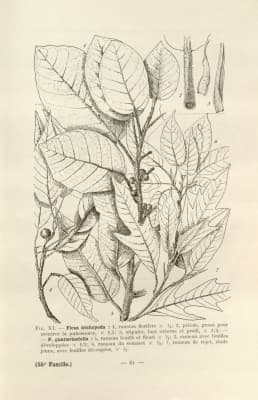
Ficus trichopoda
Ficus trichopoda
Safety & Hazards
None known
Cultivation Details
The plant can usually tolerate occasional mild frosts[1]. The plant has an aggressive root system and so should not be grown near buildings or drains since it can cause them damage[1]. Fig trees have a unique form of fertilization, each species relying on a single, highly specialized species of wasp that is itself totaly dependant upon that fig species in order to breed. The trees produce three types of flower; male, a long-styled female and a short-styled female flower, often called the gall flower. All three types of flower are contained within the structure we usually think of as the fruit. The female fig wasp enters a fig and lays its eggs on the short styled female flowers while pollinating the long styled female flowers. Wingless male fig wasps emerge first, inseminate the emerging females and then bore exit tunnels out of the fig for the winged females. Females emerge, collect pollen from the male flowers and fly off in search of figs whose female flowers are receptive. In order to support a population of its pollinator, individuals of a Ficus spp. Must flower asynchronously. A population must exceed a critical minimum size to ensure that at any time of the year at least some plants have overlap of emmission and reception of fig wasps. Without this temporal overlap the short-lived pollinator wasps will go locally extinct[2].
Propagation
Seed - although it can be stored for at least several months, it is best sown as soon as it is ripe since it will then germinate more freely and more quickly[1]. Sow the seed in containers, only just covering it with soil and then firming it down gently. Water well, but do not wash the seed away. Place in a lightly shaded position, bringing it into a sunnier place once the seedlings are a few weeks old. Prick the seedlings out into individual containers when large enough to handle. Air layering is done by selecting a suitable branch (bearing in mind this will be your new tree!) and wounding the bark almost all the way round - leave about 10% uncut. Pack damp vermiculite and sand around the wound and cover with plastic, sealing at either end. It should take about six weeks for roots to appear. If roots are there, cut the branch right off, plant in a bag and keep well watered until roots have established[1]. Cuttings - even large stems will generally root[1]. Cite as: Tropical Plants Database, Ken Fern. tropical.theferns.info. 2026-02-20. <tropical.theferns.info/viewtropical.php?id=Ficus+trichopoda>
Pollinators
Wasps
References
- [1]PlantZAfrica.com — http://www.plantzafrica.com ↩︎An excellent site giving detailed descriptions and uses of many S. African plants.
- [2]Global Invasive Species Database — http://www.issg.org/database/welcome/ ↩︎Very detailed information on almost 400 species (with more being added) of plants that have become weeds in areas outside their native range.
- [3]African Flowering Plants Database — Conservatoire et Jardin Botaniques. · http://www.ville-ge.ch/musinfo/bd/cjb/africa/recherche.php ↩︎Contains information on over 150,000 plant names (including synonyms) giving a description and habitat, plus a distribution map.
- [4]Adansonia Vol. 8. — Museum National d'Histoire Naturelle; Paris. · 1986 · http://www.biodiversitylibrary.org ↩︎Contains, amongst others, a treatment of the genus Ficus (Figs) in Madagascar and Mauritius. It can be downloadd from the Internet.