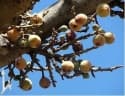
Ficus sycomorus
Ficus sycomorus
Safety & Hazards
None known
Cultivation Details
A plant of drier areas in the tropics and subtropics. It is found at elevations ranging from sea level to 2,000 metres, growing in areas where the temperature can fall as low as 0°c or go up to 40°c[1]. The tree is sensitive to frost but can withstand some cold[1]. It succeeds in areas where the mean annual rainfall can vary from 500 - 1,800mm, with a maximum of 2,200mm[1]. Grows best in a sunny position[2]. Prefers a deep, well-drained loam to clay soil rich in nutrients[1]. Sandy soils with a shallow groundwater level may also be suitable[1]. The best site for trees is next to drainage lines, streams, rivers, springs or dams[1]. Prefers a pH in the range 5.5 - 7, tolerating 5 - 7.5[2]. In at least some parts of its range the tree can flower and fruit throughout the year[1]. A tree can bear several crops of fruit a year[1]. Plants tolerate lopping[1]. Continuous and adequate water supply is necessary for high yields, but rainfall during fruiting may cause fruits to split and favour growth of fungal rots[1]. The tree has an invasive root system, which should be borne in mind when positioning trees[1]. Growth rate is fairly fast at 1 - 1.5 m/year in frost-free areas[1]. Fig trees have a unique form of fertilization, each species relying on a single, highly specialized species of wasp that is itself totaly dependant upon that fig species in order to breed. The trees produce three types of flower; male, a long-styled female and a short-styled female flower, often called the gall flower. All three types of flower are contained within the structure we usually think of as the fruit. The female fig wasp enters a fig and lays its eggs on the short styled female flowers while pollinating the long styled female flowers. Wingless male fig wasps emerge first, inseminate the emerging females and then bore exit tunnels out of the fig for the winged females. Females emerge, collect pollen from the male flowers and fly off in search of figs whose female flowers are receptive. In order to support a population of its pollinator, individuals of a Ficus spp. must flower asynchronously. A population must exceed a critical minimum size to ensure that at any time of the year at least some plants have overlap of emmission and reception of fig wasps. Without this temporal overlap the short-lived pollinator wasps will go locally extinct[3].
Propagation
Seed - viable seed is difficult to obtain[1]. It germinates best at a temperature around 20°c[4]. Branches with a diameter of 50-150 mm can be used as large cuttings planted direct into the soil[1]. To avoid rotting of the tips, they must be left in the shade for a few days to dry before planting[1]. Most of the leaves should be removed before planting in 1 metre deep holes with some sand at the bottom. This prevents rotting of the cuttings and stimulates root formation[1]. Smaller cuttings can also be made from either the mature wood or from wood of the current season's growth[1]. They are first planted in the nursery to induce rooting and then planted out in the field[1]. Cite as: Tropical Plants Database, Ken Fern. tropical.theferns.info. 2026-02-20. <tropical.theferns.info/viewtropical.php?id=Ficus+sycomorus>
Pollinators
Wasps
References
- [1]World Agroforesty Centre — http://www.worldagroforestry.org/ ↩︎An excellent online database of a huge range of trees giving very good information on each plant - its uses, ecology, identity, propagation, pests etc.
- [2]Ecocrop — http://ecocrop.fao.org/ecocrop/srv/en/home ↩︎Basic information on a wide range of useful plants, plus details of environmental needs where available.
- [3]Global Invasive Species Database — http://www.issg.org/database/welcome/ ↩︎Very detailed information on almost 400 species (with more being added) of plants that have become weeds in areas outside their native range.
- [4]The New RHS Dictionary of Gardening. 1992. — Huxley. A. · MacMillan Press · 1992 · ISBN 0-333-47494-5 ↩︎Excellent and very comprehensive, though it contains a number of silly mistakes. Readable yet also very detailed.
- [5]Trees and Shrubs of the Sahel. Their Characteristics and Uses. — von Maydell H. · Deutsche Gesellschaft fur Technische Zusammenarbeit; Germany · 1990 · ISBN 3-8236-1198-4 ↩︎A well-researched book, usually with more than one photograph of each species and good information on the plant and its uses.
- [6]Mansfeld's Database of Agricultural and Horticultural Plants — http://mansfeld.ipk-gatersleben.de/pls/htmldb_pgrc/f?p=185:3:4292127278597336 ↩︎Terse details of a huge range of useful plants.
- [7]Dictionary of Economic Plants. — Uphof. J. C. Th. · Weinheim · 1959 · ISBN - ↩︎An excellent and very comprehensive guide but it only gives very short descriptions of the uses without any details of how to utilize the plants. Not for the casual reader.
- [8]Cornucopia II — Facciola. S. · Kampong Publications, California. · 1998 · ISBN 0-9628087-2-5 ↩︎The second edition of an excellent guide to the edible uses of plants, though it does not give any details of cultivation etc.
- [9]Edible Wild Plants of Tanzania — Ruffo, C.K.: Birnie, A. & Tengnas, B. · Regional Land Management Unit; Nairobi. · 2002 · ISBN 9966-896-60-0 ↩︎A very well presented, simple guide to growing and utilizing wild food plants in Tanzania, with line drawings of each plant, a description, habitat and range, non-food as well as food uses, plus basic information on growing the plants.
- [10]Field Guide to the Moist Forest Trees of Tanzania. — Lovett J.C.; Ruffo C.K.; Gereau R.E.; Taplin J.R.D · Frontier · http://www.york.ac.uk/res/celp/webpages/projects/ecology/tree%20guide/introduction.htm · ISBN 1-873070-33-0 ↩︎A lovely little book giving a basic identification guide to more than 650 species of trees growing in Tanzania. It is also available to view on the internet.
- [11]Anti-diarrheal Activity of the leaf extracts of Daniellia oliveri Hutch and Dalz (Fabaceae) and Ficus sycomorus Miq — Ahmadu A.A.; Zezi A.U.; & Yaro A.H. · 2007 · http://www.africanethnomedicines.net · ISBN 0189-6016 ↩︎
- [12]Protabase - Plant Resources of Tropical Africa. — http://www.prota.org ↩︎An excellent on-line database with detailed information on over 3,200 species of useful plants of Africa.