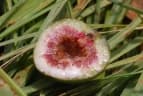
Ficus sur
Ficus sur
Safety & Hazards
Although used medicinally, the plant contains toxic substances - both root and bark decoctions are recorded to have caused death[1]. The latex and decoctions of the twig and leaf are recorded as being used for arrow poison, and the plant has been used for criminal poisoning[1]. The wood is recorded as causing dermatitis in workers handling it[1].
Cultivation Details
Succeeds in tropical and subtropical climates. Young trees are sensitive to frost[1]. In Tanzania it grows in areas where the mean annual rainfall is in the range 800 - 1,800mm[2]. The tree prefers full sun, but tolerates partial shade[1]. Grows on a wide range of soil types, though it thrives best in red sandy clay loams and sandy loams[1, 2]. Prefers moist sites, growing well near watercourses[3]. Young plants grow fast and may reach a height of 1 metre or more in the second year[1]. Plants have an aggressive root system and so should not be planted near buildings, draines etc, because they could damage the foundations[4]. The tree responds well to coppicing and pollarding[1]. The fig is not a true fruit but a fruit-like structure (syconium) developed from an inside-out flower stalk containing many flowers inside[1]. This is a closed structure with only a small opening at the top through which small female wasps enter, after which they lay eggs in special infertile 'gall flowers', while pollinating the fertile female flowers[1]. The figs are borne in large clusters mostly low down on the trunk and can even appear at ground level arising from the roots[4]. Fig trees have a unique form of fertilization, each species relying on a single, highly specialized species of wasp that is itself totaly dependant upon that fig species in order to breed. The trees produce three types of flower; male, a long-styled female and a short-styled female flower, often called the gall flower. All three types of flower are contained within the structure we usually think of as the fruit. The female fig wasp enters a fig and lays its eggs on the short styled female flowers while pollinating the long styled female flowers. Wingless male fig wasps emerge first, inseminate the emerging females and then bore exit tunnels out of the fig for the winged females. Females emerge, collect pollen from the male flowers and fly off in search of figs whose female flowers are receptive. In order to support a population of its pollinator, individuals of a Ficus spp. must flower asynchronously. A population must exceed a critical minimum size to ensure that at any time of the year at least some plants have overlap of emmission and reception of fig wasps. Without this temporal overlap the short-lived pollinator wasps will go locally extinct[5].
Propagation
Seed - germinates best at a temperature around 20°c[6]. The seed should be sown on a fine medium and remain uncovered[1]. They germinate in 15 - 20 days[1]. Seedlings are ready for planting out in the open when they are 1 metre tall[1]. Air layering[6]. Tip cuttings around 4 - 12cm long, taken from lateral branches[6]. Plant in moist sand[1]. Cite as: Tropical Plants Database, Ken Fern. tropical.theferns.info. 2026-02-20. <tropical.theferns.info/viewtropical.php?id=Ficus+sur>
Pollinators
Wasps
References
- [1]Protabase - Plant Resources of Tropical Africa. — http://www.prota.org ↩︎An excellent on-line database with detailed information on over 3,200 species of useful plants of Africa.
- [2]Edible Wild Plants of Tanzania — Ruffo, C.K.: Birnie, A. & Tengnas, B. · Regional Land Management Unit; Nairobi. · 2002 · ISBN 9966-896-60-0 ↩︎A very well presented, simple guide to growing and utilizing wild food plants in Tanzania, with line drawings of each plant, a description, habitat and range, non-food as well as food uses, plus basic information on growing the plants.
- [3]Trees and Shrubs of the Sahel. Their Characteristics and Uses. — von Maydell H. · Deutsche Gesellschaft fur Technische Zusammenarbeit; Germany · 1990 · ISBN 3-8236-1198-4 ↩︎A well-researched book, usually with more than one photograph of each species and good information on the plant and its uses.
- [4]PlantZAfrica.com — http://www.plantzafrica.com ↩︎An excellent site giving detailed descriptions and uses of many S. African plants.
- [5]Global Invasive Species Database — http://www.issg.org/database/welcome/ ↩︎Very detailed information on almost 400 species (with more being added) of plants that have become weeds in areas outside their native range.
- [6]The New RHS Dictionary of Gardening. 1992. — Huxley. A. · MacMillan Press · 1992 · ISBN 0-333-47494-5 ↩︎Excellent and very comprehensive, though it contains a number of silly mistakes. Readable yet also very detailed.
- [7]Sturtevant's Edible Plants of the World. — Hedrick. U. P. · Dover Publications · 1972 · ISBN 0-486-20459-6 ↩︎Lots of entries, quite a lot of information in most entries and references.
- [8]Cornucopia II — Facciola. S. · Kampong Publications, California. · 1998 · ISBN 0-9628087-2-5 ↩︎The second edition of an excellent guide to the edible uses of plants, though it does not give any details of cultivation etc.
- [9]Flora of Zimbabwe — http://www.zimbabweflora.co.zw/ ↩︎Over 2,000 species as of 2009 (and growing). Each record usually has at least one photo with a botanical description of the plant, range, habitat etc. A very useful site.
- [10]Traditional Vegetables in Benin — Achigan-Dako E. Et al · Darwin Initiative; International Foundation for Science · 2009 ↩︎Issued as a PDF on the Internet, it contains basic information on over 250 species of plants used for food in Benin.
- [11]Useful Plants of Nyasaland — Williamson J. · The Government Printer, Zomba, Nyasaland. · 1955 · http://www.biodiversitylibrary.org ↩︎Brief details of the uses of almost 500 species of plants.