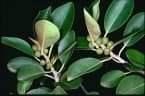
Ficus rubiginosa
Ficus rubiginosa
Safety & Hazards
None known
Cultivation Details
The tree occurs in climates ranging from tropical to warm temperate, and from the well watered coast inland to areas bordering on semi-arid. Established plants can withstand short periods where the temperature drops to around -1°c[1]. Easily grown in full sun or partial shade[1]. Tolerant of extremes of soil fertility, it thrives on a variety of well-drained soils[1]. It remains small in poor growing conditions, but if its roots reach better soils then it transforms into a large, free standing tree, thriving on high fertility soils[1]. Once it is established, it can withstand periods of drought[1]. The tree has been successfully grown in urban areas where air pollution, poor drainage, compacted soil, and/or drought are common[2, 1]. The tree is often grown as an ornamental. It requires a specific species of minute wasp to effect pollination of the flowers and cannot produce seed in the absence of the wasp. If by any chance the wasp shoupd be introduced to areas where the tree is grown as an ornamental (as has happened in Hawaii and New Zealand), then the tree often excapes from cultivation into the wild and can harm native environments[3]. Rather slow-growing[1]. Fig trees have a unique form of fertilization, each species relying on a single, highly specialized species of wasp that is itself totaly dependant upon that fig species in order to breed. The trees produce three types of flower; male, a long-styled female and a short-styled female flower, often called the gall flower. All three types of flower are contained within the structure we usually think of as the fruit. The female fig wasp enters a fig and lays its eggs on the short styled female flowers while pollinating the long styled female flowers. Wingless male fig wasps emerge first, inseminate the emerging females and then bore exit tunnels out of the fig for the winged females. Females emerge, collect pollen from the male flowers and fly off in search of figs whose female flowers are receptive. In order to support a population of its pollinator, individuals of a Ficus spp. Must flower asynchronously. A population must exceed a critical minimum size to ensure that at any time of the year at least some plants have overlap of emmission and reception of fig wasps. Without this temporal overlap the short-lived pollinator wasps will go locally extinct[1].
Propagation
Seed - as a hemi-epiphyte or lithophyte, the plant must be able to germinate and initially grow in low nutrient, arid conditions[1]. Cuttings Cite as: Tropical Plants Database, Ken Fern. tropical.theferns.info. 2026-02-20. <tropical.theferns.info/viewtropical.php?id=Ficus+rubiginosa>
Pollinators
Wasps
References
- [1]Global Invasive Species Database — http://www.issg.org/database/welcome/ ↩︎Very detailed information on almost 400 species (with more being added) of plants that have become weeds in areas outside their native range.
- [2]Institute of Food and Agricultural Sciences, University of Florida — University of Florida · http://hort.ifas.ufl.edu/shrubs/ ↩︎PDF fact sheets on over 500 shrubs.
- [3]Pacific Island Ecosystems at Risk — http://www.hear.org/pier/scientificnames/index.html ↩︎A very good website detailing weed species that have been introduced into the Pacific Islands.
- [4]Flora of Australia — http://www.anbg.gov.au/abrs/abif/flora/ ↩︎The full information from the Flora of Australia - on-line. An excellent resource.
- [5]Australian Tropical Rainforest Plants — http://www.anbg.gov.au/cpbr/cd-keys/rfk/index.html ↩︎An online resource giving botanical information, and a little bit about plant usage, for over 2,700 species of plants found in the Australian rainforest.
- [6]Bush Foods of New South Wales — Stewart S.; Percival B. · Royal Botanic gardens; Sydney, Australia. · 1997 · http://www.rbgsyd.nsw.gov.au/education/Resources/bush_foods · ISBN 07313-0004-1 ↩︎A small booklet with information on more than 30 species of edible plants. It can be downloaded from the Internet.
- [7]The Useful Native Plants of Australia. — Maiden J.H. · Turner & Co.; London. · 1889 · http://www.biodiversitylibrary.org ↩︎Terse details of the uses of many Australian plants and other species naturalised, or at least growing, in Australia. It can be downloaded from the Internet.