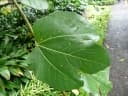
Ficus palmata
Ficus palmata
Safety & Hazards
The sap and the half-ripe fruits are said to be poisonous.
Cultivation Details
Ficus palmata is a plant of the warm temperate to subtropical zones, also found at higher elevations of 1,000 metres or more in the tropics. Young growth, even on mature plants, is frost-tender. Requires a well-drained medium to light loam and some lime rubble incorporated into the soil. A heavy wet soil tends to encourage excessive plant growth at the expense of fruit. This species has been recommended for growing in areas where the climate is too wet for common figs (Ficus carica) since it fruits during the monsoon season in the Himalayas. However, it probably requires the fig-wasp in order to pollinate the flowers and so is unlikely to fruit in areas that are too cold for the fig-wasp to survive. Annual yields from wild trees is about 25kg[1]. There is a potential for commercial cultivation[1]. Fig trees have a unique form of fertilization, each species relying on a single, highly specialized species of wasp that is itself totaly dependant upon that fig species in order to breed. The trees produce three types of flower; male, a long-styled female and a short-styled female flower, often called the gall flower. All three types of flower are contained within the structure we usually think of as the fruit. The female fig wasp enters a fig and lays its eggs on the short styled female flowers while pollinating the long styled female flowers. Wingless male fig wasps emerge first, inseminate the emerging females and then bore exit tunnels out of the fig for the winged females. Females emerge, collect pollen from the male flowers and fly off in search of figs whose female flowers are receptive. In order to support a population of its pollinator, individuals of a Ficus spp. must flower asynchronously. A population must exceed a critical minimum size to ensure that at any time of the year at least some plants have overlap of emmission and reception of fig wasps. Without this temporal overlap the short-lived pollinator wasps will go locally extinct[2].
Propagation
Seed - sow spring in a warm greenhouse. Prick out the seedlings as soon as they are large enough to handle and overwinter the young plants in a greenhouse for at least their first year. Plant out in late spring after the last expected frosts and give some protection for their first winter outdoors. Cuttings of mature wood 10 - 12cm with a heel, winter in a frame. Fairly easy, but the cuttings must be kept frost free. It is probably best if the cuttings are put in individual pots[3]. Layering. Cite as: Temperate Plants Database, Ken Fern. temperate.theferns.info. 2026-02-21. <temperate.theferns.info/plant/Ficus+palmata>
Pollinators
Wasps
References
- [1]Wild Fruits of the Sub-Himalayan Region. — Parmar. C. and Kaushal. M.K. · Kalyani Publishers. New Delhi. · 1982 · ISBN - ↩︎Contains lots of information on about 25 species of fruit-bearing plants of the Himalayas, not all of them suitable for cool temperate zones.
- [2]Global Invasive Species Database — http://www.issg.org/database/welcome/ ↩︎Very detailed information on almost 400 species (with more being added) of plants that have become weeds in areas outside their native range.
- [3]Propagation of Trees, Shrubs and Conifers. — Sheat. W. G. · MacMillan and Co · 1948 · ISBN - ↩︎A bit dated but a good book on propagation techniques with specific details for a wide range of plants.
- [4]Mansfeld's Database of Agricultural and Horticultural Plants — http://mansfeld.ipk-gatersleben.de/pls/htmldb_pgrc/f?p=185:3:4292127278597336 ↩︎Terse details of a huge range of useful plants.
- [5]Plants and People of Nepal — Manandhar. N. P. · Timber Press. Oregon. · 2002 · ISBN 0-88192-527-6 ↩︎Excellent book, covering over 1,500 species of useful plants from Nepal together with information on the geography and peoples of Nepal. Good descriptions of the plants with terse notes on their uses.
- [6]Sturtevant's Edible Plants of the World. — Hedrick. U. P. · Dover Publications · 1972 · ISBN 0-486-20459-6 ↩︎Lots of entries, quite a lot of information in most entries and references.
- [7]Glossary of Indian Medicinal Plants (Including the Supplement). — Chopra. R. N., Nayar. S. L. and Chopra. I. C. · Council of Scientific and Industrial Research, New Delhi. · 1986 · ISBN - ↩︎Very terse details of medicinal uses of plants with a wide range of references and details of research into the plants chemistry. Not for the casual reader.
- [8]Ethnobotanical Studies of Useful Trees of District Kotli, Azad Jammu and Kashmir — Muhammad Ajaib & Zaheer-Ud-Din Khan · 2014 · ISBN 2313-206X ↩︎