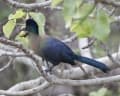
Ficus abutilifolia
Ficus abutilifolia
Safety & Hazards
None known
Cultivation Details
A plant of the dry to wet, lowland tropics, where it is found at elevations up to 500 metres. It grows best in areas where annual daytime temperatures are within the range 18 - 25°c, but can tolerate 14 - 30°c[1]. Able to tolerate light frosts[2], it can be killed by temperatures of -1°c or lower[1]. It prefers a mean annual rainfall in the range 400 - 2,500mm, but tolerates 250 - 3,000mm[1]. Requires a sunny position[1]. Prefers a light, moderately fertile, well-drained soil[1]. Prefers a pH in the range 6 - 6.5, tolerating 5.5 - 7[1]. Plants can produce roots up to 60 metres long, these seeking out sources of underground water and making the plant very drought tolerant[2]. The plant can flower all year round[3]. Fig trees have a unique form of fertilization, each species relying on a single, highly specialized species of wasp that is itself totaly dependant upon that fig species in order to breed. The trees produce three types of flower; male, a long-styled female and a short-styled female flower, often called the gall flower. All three types of flower are contained within the structure we usually think of as the fruit. The female fig wasp enters a fig and lays its eggs on the short styled female flowers while pollinating the long styled female flowers. Wingless male fig wasps emerge first, inseminate the emerging females and then bore exit tunnels out of the fig for the winged females. Females emerge, collect pollen from the male flowers and fly off in search of figs whose female flowers are receptive. In order to support a population of its pollinator, individuals of a Ficus spp. Must flower asynchronously. A population must exceed a critical minimum size to ensure that at any time of the year at least some plants have overlap of emmission and reception of fig wasps. Without this temporal overlap the short-lived pollinator wasps will go locally extinct[4].
Propagation
Seed - best sown as soon as it is ripe in a lightly shaded position in a nursery seedbed. Germination can be expected within 10 - 30 days depending on temperature and the freshness of the seed - fresh seed and warm temperatures will favour more rapid germination[2]. Seedlings should be placed in a sunny position and eventually transplanted into a well-drained sandy mix rich in organic matter[2]. Cuttings are not as easy as many other species in this genus, but can be successful[2]. Take softwood or semi-hardwood cuttings, around 20 - 25cm long. Remove the lower leaves from the stem. Insert into a washed river sand mix and place in a misting unit, or if this is not available, place the tray with cuttings inside a clear plastic bag to reduce the adverse effects of transpiration. These should root within a month and be ready for transplanting in a further 3 - 4 weeks into a rich, well-drained medium[2]. Cite as: Tropical Plants Database, Ken Fern. tropical.theferns.info. 2026-02-20. <tropical.theferns.info/viewtropical.php?id=Ficus+abutilifolia>
Pollinators
Wasps
References
- [1]Ecocrop — http://ecocrop.fao.org/ecocrop/srv/en/home ↩︎Basic information on a wide range of useful plants, plus details of environmental needs where available.
- [2]PlantZAfrica.com — http://www.plantzafrica.com ↩︎An excellent site giving detailed descriptions and uses of many S. African plants.
- [3]Traditional Vegetables in Benin — Achigan-Dako E. Et al · Darwin Initiative; International Foundation for Science · 2009 ↩︎Issued as a PDF on the Internet, it contains basic information on over 250 species of plants used for food in Benin.
- [4]Global Invasive Species Database — http://www.issg.org/database/welcome/ ↩︎Very detailed information on almost 400 species (with more being added) of plants that have become weeds in areas outside their native range.
- [5]The Useful Plants of West Tropical Africa. — Burkil. H. M. · Royal Botanic Gardens; Kew. · 1985 - 2004 ↩︎Brief descriptions and details of the uses of over 4,000 plants. A superb, if terse, resource, it is also available electronically on the Web - see http://www.aluka.org/