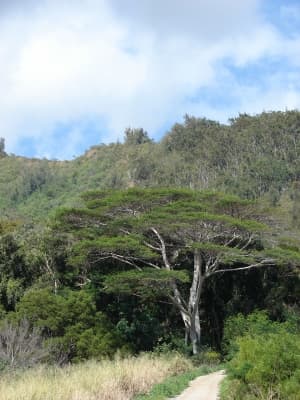
Falcataria moluccana
Falcataria moluccana
Safety & Hazards
Dust from machining may be irritating[1].
Cultivation Details
Batai is a tree of low to medium elevations of the wetter tropics, succeeding from sea level to elevations of 1,200 metres[2]. It succeeds in areas where the mean annual temperature is in the range 22 - 29°c and the mean annual rainfall is 2,000 - 4,000mm, averaging 2,800mm[2]. It is adapted to peri-humid and monsoonal climates with a dry season of up to 4 months[2]. Requires a sunny position[2]. Trees can succeed on comparatively poor sites and survive without fertilizer[2]. However, they do not thrive in poorly drained, flooded or waterlogged soils[2]. Prefers a pH in the range 5 - 8, tolerating 4.5 - 8.5[3]. Plants require a position sheltered from strong winds[2]. Batai grows so fast that it is sometimes called the 'miracle tree'. It is even mentioned in the Guinness Book of Records as the world's fastest growing tree[2]. On good sites it can attain a height of 7 metres in just over a year. Trees reach a mean height of 25.5 metres and a bole diameter of 17cm after 6 years, 32.5 metres high and 40.5cm diameter after 9 years, 38 metres high and 54cm diameter after 12 years, and 39 metres high and 63.5cm diameter after 15 years[2]. Trees may flower when as young as 3 years[2]. Two flowering periods per year have been observed in some areas[2]. Ripe pods appear approximately 2 months after flowering. The pods dehisce when ripe, often when still attached to the tree, scattering the seeds on the ground[2]. Trees are sensitive to fire[2]. The tree responds to coppicing, although coppicing vigour is highly variable[2]. Batai is commonly used in agroforestry systems, usually in a cutting cycle of 10 - 15 years, in combination with annual crops in the 1st year and grazing animals in subsequent years[2]. This species has a symbiotic relationship with certain soil bacteria, these bacteria form nodules on the roots and fix atmospheric nitrogen. Some of this nitrogen is utilized by the growing plant but some can also be used by other plants growing nearby[4]. Growth of young trees in a phosphorous-deficient soil is promoted by inoculation with mycorrhizal fungi Gigaspora margarita and Glomus fasciculatum in combination with Rhizobium.
Propagation
Seed - untreated seeds germinate irregularly; germination may start after 5 - 10 days but is sometimes delayed for up to 4 weeks[2]. To hasten and ensure uniform germination, add a small quantity of almost boiling water to the seed. The quantity of water should not be too great to ensure that it cools down without cooking the seed. Then soak the seed in warm water for 12 - 24 hours prior to sowing. Germination rates can be as high as 80% to almost 100%[2]. The seed is usually sown by broadcasting on a seedbed, pressing it gently into the soil and then covering it with a layer of fine sand up to 15mm thick. The soil in the seedbed must be loose and well drained; application of a surface layer of mulch is advisable, and excessive shading should be avoided[2]. Seedlings can be transplanted when they have reached a height of 20 - 25cm with a woody stem and a good fibrous root system; this stage can be reached in 8 - 11 weeks. Container plants are often transplanted into the field when 4 - 5 months old[2]. Small seeds are difficult to collect from the ground and are usually collected by cutting down branches bearing ripe, brown pods. Seed storage behaviour is orthodox. There is no loss in viability during 1.5 years in air-dry storage at 4-8 deg. C. For storage, seeds are air dried for 24 hours and then packed in polythene bags. When stored at 4-8 deg. C, the germination rate after 18 months may still be 70-90%[2]. Cite as: Tropical Plants Database, Ken Fern. tropical.theferns.info. 2026-02-20. <tropical.theferns.info/viewtropical.php?id=Falcataria+moluccana>
Pollinators
Insects
References
- [1]Tropical Timbers of the World. Ag. Handbook No. 607. — Chudnoff. Martin. · USDA Forest Service. Wisconsin. · 1984 ↩︎Terse details on the properties of the wood of almost 400 species of trees from the Tropics.
- [2]World Agroforesty Centre — http://www.worldagroforestry.org/ ↩︎An excellent online database of a huge range of trees giving very good information on each plant - its uses, ecology, identity, propagation, pests etc.
- [3]Ecocrop — http://ecocrop.fao.org/ecocrop/srv/en/home ↩︎Basic information on a wide range of useful plants, plus details of environmental needs where available.
- [4]The New RHS Dictionary of Gardening. 1992. — Huxley. A. · MacMillan Press · 1992 · ISBN 0-333-47494-5 ↩︎Excellent and very comprehensive, though it contains a number of silly mistakes. Readable yet also very detailed.
- [5]Seed Leaflets — Various · Forest & Landscape. Denmark · http://en.sl.life.ku.dk/Publikationer/Udgivelser/PopulaerPublikationer.aspx?katid={D28373CC-6EF3-4EF8-B097-6D83FABF209E}&serieid={9F1C3DB1-6E7B-4CF1-AF53-F480B0CB40EF}&sort=title ↩︎A series of leaflets, jointly produced by the University of Copenhagen and the Royal Botanic Gardens at Kew, focussing on seed information for a number species, but also giving a lot of other information about each plant.
- [6]Medicinal Plants in Papua New Guinea — World Health Organisation · 2009 · ISBN 978-92-9061-249-0 ↩︎Traditional medicinal uses of 126 species from Papua New Guinea, including information on modern research into the plants.